
Overview
The Communication Hub is your inbox and engagement control center, where your team can view, automate, manage, and customize all guest communications from one screen.
Every conversation with a guest arrives in the same place, no matter which channel the guest used: Guest app Chat, SMS, WhatsApp, Email, WeChat, your PMS, and the OTA inboxes of Airbnb, Booking.com, and Expedia Group. From a single conversation, you can reply on the right channel, see the full reservation and guest context, loop in a colleague with an internal note, assign the conversation to a person or a team, and let Duve's AI draft, rewrite, or prioritize for you.
Video preview about the Communication hub
Applies to
Pricing
|
Use cases
- Run a front desk or guest experience team out of one inbox instead of switching between a WhatsApp phone, an OTA extranet, and a mailbox.
- Give each agent a personal queue by assigning conversations to people, and give each shift or department a shared queue by assigning conversations to teams.
- Catch the conversations that matter first, using priority levels and the AI priority signal based on guest sentiment and topic.
- Hand a request forward in time instead of losing it, by snoozing a conversation until the day before check-in.
- Coordinate internally on a guest issue with internal notes and @ mentions, without the guest ever seeing it.
- Send one message to a filtered group of guests, for example, everyone departing on the morning of a marathon that closes the streets.
- Finish the guest journey on the guest's behalf from Quick Actions, for example, completing online check-in at the desk or sending a step to the guest's device.
- Answer guests in their own language without writing it, using auto-translation on both sides of the conversation.
Before you start
- Connect the channels you want to use. WhatsApp needs an approved sender and, for messages outside an open session, approved templates. SMS needs SMS billing enabled. OTA inboxes need the matching connection to be active.
- Create your canned responses so your team has ready answers to pick from.
- Create user teams if you want to assign conversations to a team rather than to one person. A team created under a brand is only offered on conversations belonging to that brand.
- Set each user's notification preferences so new messages, assignments, and mentions reach the right people.
- If you want the AI features, have Smart Reply and Smart Priority enabled on your account and have your AI settings reviewed. AI settings can be overridden per brand.
How to use it
Where to find the Communication Hub
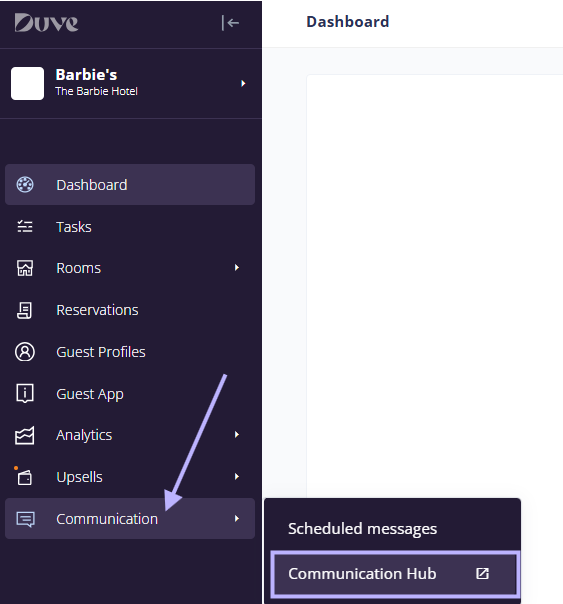
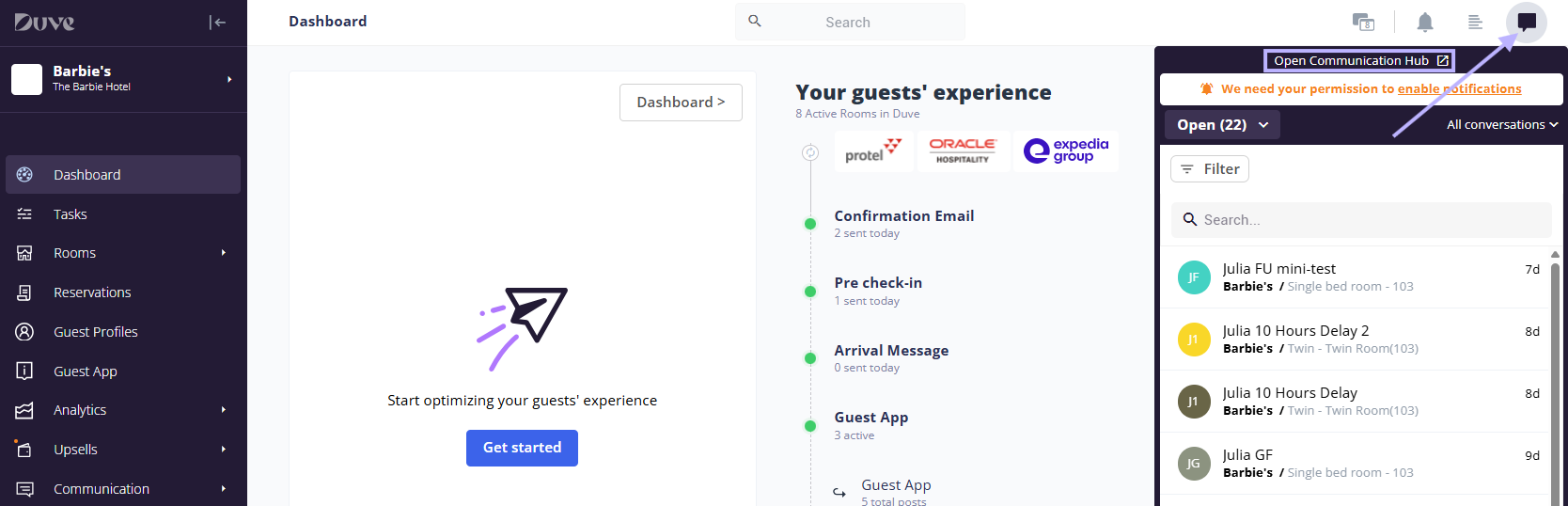
Open the Communication Hub from the main menu in your Duve account. It is also available inside a single reservation and as a side panel on other pages.
Navigating the inbox
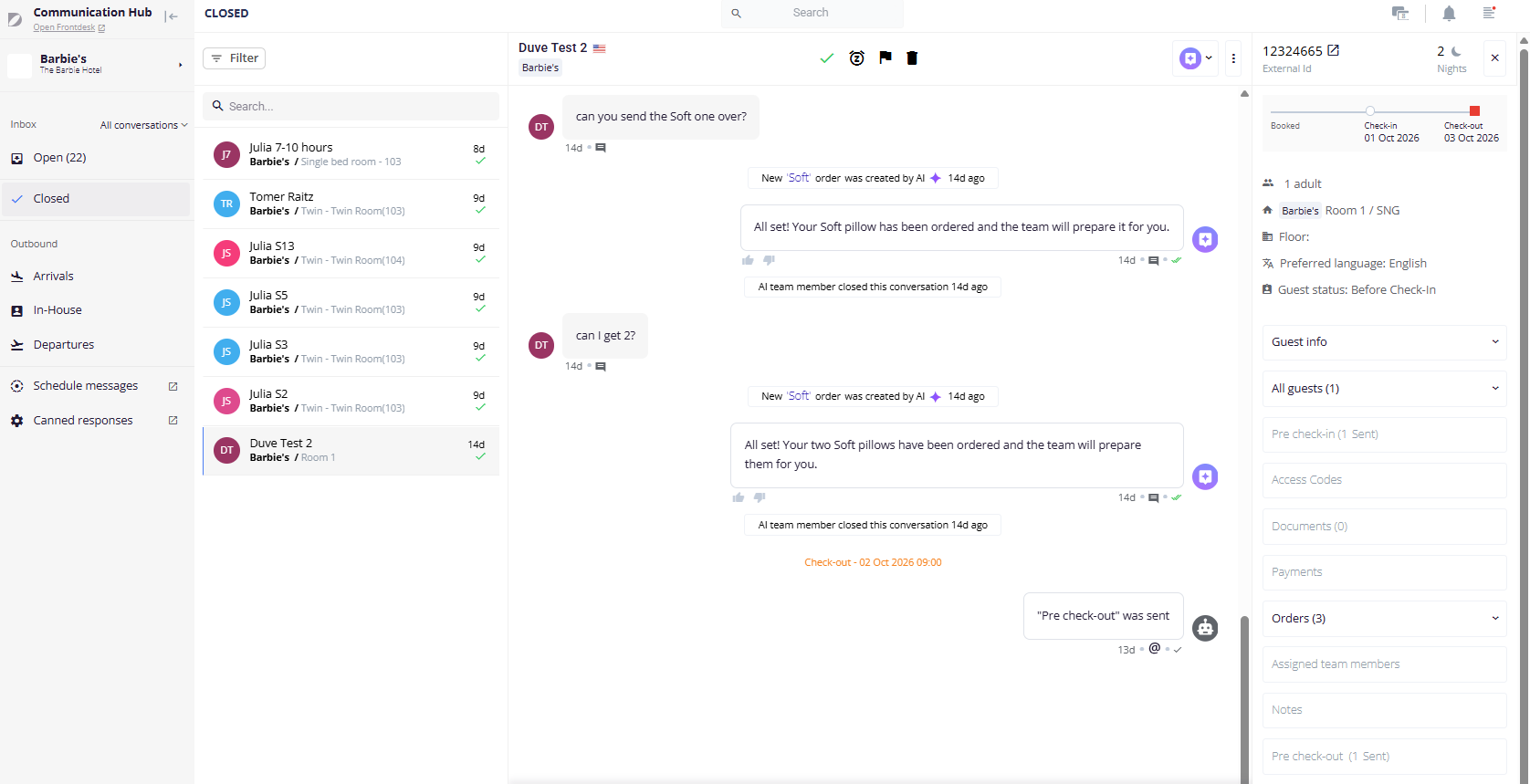
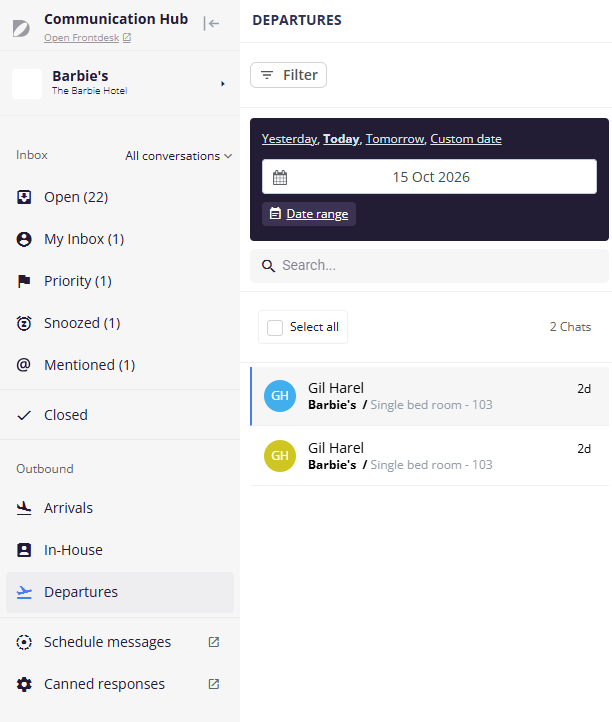
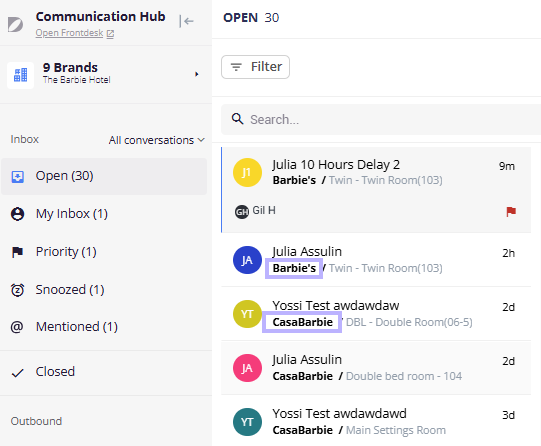
The left menu groups conversations into folders. Each folder shows a count, and unread conversations are marked.
- Open: all open conversations in the Hub.
- My Inbox: conversations assigned to you, and conversations assigned to a team you belong to.
- Priority: conversations flagged with a priority level.
- Snoozed: conversations you have snoozed, waiting to reappear.
- Mentioned: conversations where a colleague mentioned you.
- Closed: conversations you have marked as closed. They stay available here for 14 days after they were closed.
Troubleshooting Note: Those folders won't appear if there won't be any conversation in them.
Below these, the outbound folders hold guests who have not written to you yet, grouped by where they are in their stay:
- Arrivals
- In-House
- Departures
Each outbound folder has its own date filter. You can pick a single day (Yesterday, Today, Tomorrow, or a custom date) or switch to a range (Last week, This week, Next week, or a custom range). Once a guest replies, the conversation also appears in Open.
Schedule Messages and Canned responses is a shortcut link that opens your pre-scheduled messages in a new tab. (You can also find them in Settings > Communication > Canned Responses, and Main Dashboard > Communication > Schedule Messages)
Finding a conversation
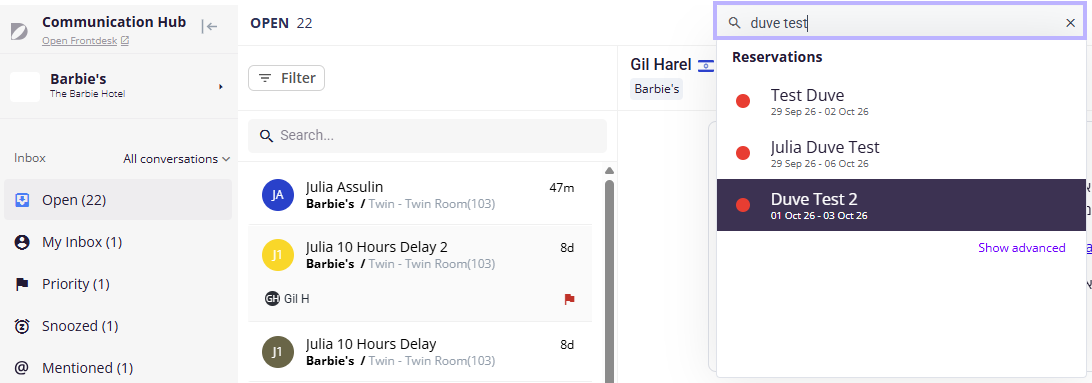
- Search across conversations by guest first or last name, email, phone, reservation external ID, OTA or booking source ID, booking status, property name, property tags, and message text.
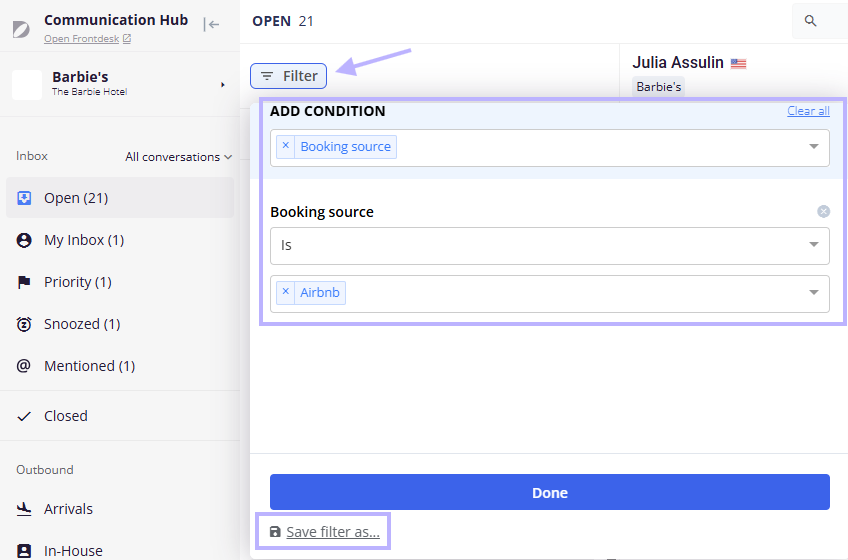
- Filter the list by reservation and guest attributes, including booking source, reservation status, plan type, guests' purchases, membership, arrival method, and pre-check-in status.
- Save a filter you use often. Give it a name, and it appears as a saved filter you can apply in one click.
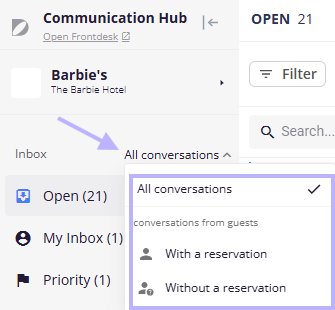
- On the inbound view, you can narrow to All conversations, only conversations With a reservation, or only those Without a reservation.
- Use the up and down arrow keys to move between conversations, and the arrows in the conversation header to step to the next or previous one.
Sending a message to a guest
Type in the open field at the bottom of the conversation and pick the channel you want to send on. The available channels depend on what is connected and on where the conversation came from:
- Chat, which reaches the guest in the Guest app.
- SMS.
- WhatsApp.
- Email.
- Airbnb, Booking.com, Expedia Group, and WeChat, for conversations that started in those inboxes.
- Your PMS, where a two-way messaging connection exists (such as Hostaway).
In the message box, you can also:
- Attach an image or a file.
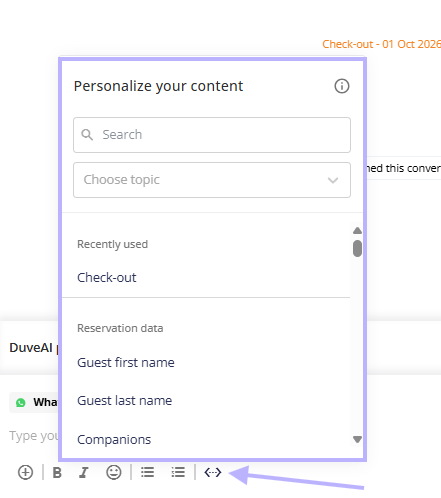
- Insert dynamic parameters.
- Insert a canned response.
- Have AI rewrite what you wrote.
- Switch to an internal note ("Add note") instead of a guest-facing message.
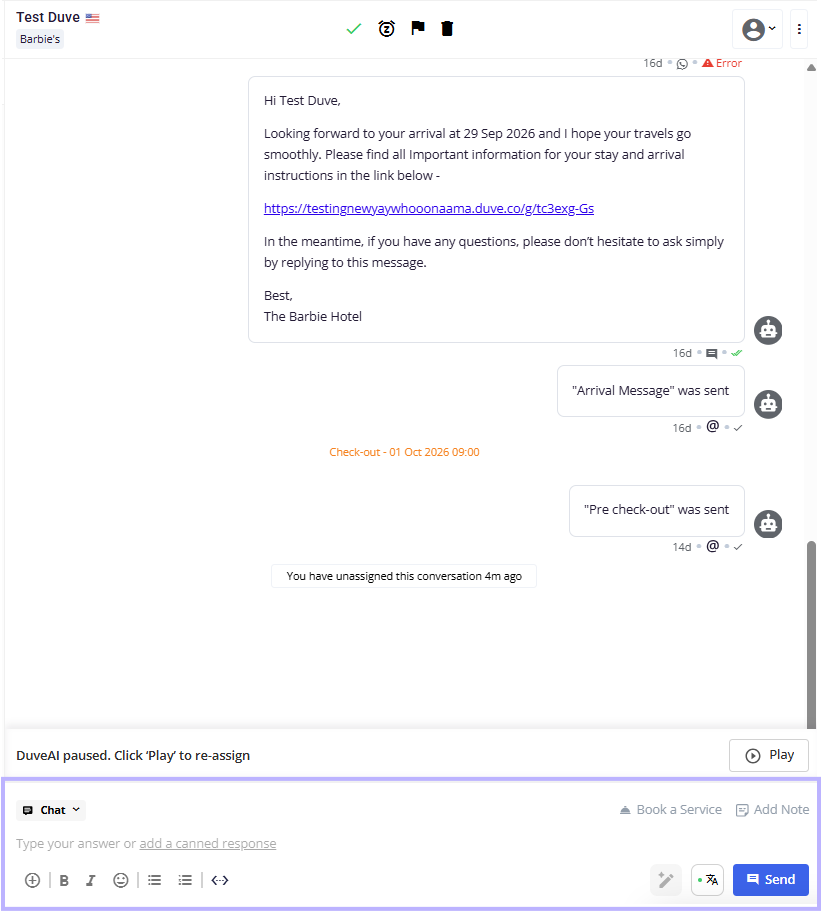
SMS and WhatsApp show a character and message counter as you type, so you can see when your text will be split into more than one message (for SMS), and when you reach your limit (for WhatsApp)
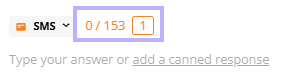
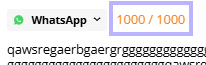
Important note: Chat messages sent to guests that are not opened in the Guest app Chat are sent by email instead if the guest does not view the chat message in the Guest app within 3 minutes.
WhatsApp sessions and templates
WhatsApp only allows free text while a session with the guest is open. Duve tracks the last message the guest sent on WhatsApp. Once 24 hours have passed since that message, or if the guest has never written to you on WhatsApp, you send an approved WhatsApp template instead of free text. Templates are offered in the same place as canned responses for the WhatsApp channel.
Dynamic parameters
Dynamic parameters personalize a message with information pulled from the guest profile, the reservation, or the room or rental. Guest app posts and upsells also have dynamic parameters, so you can link them straight into the conversation.
Canned responses
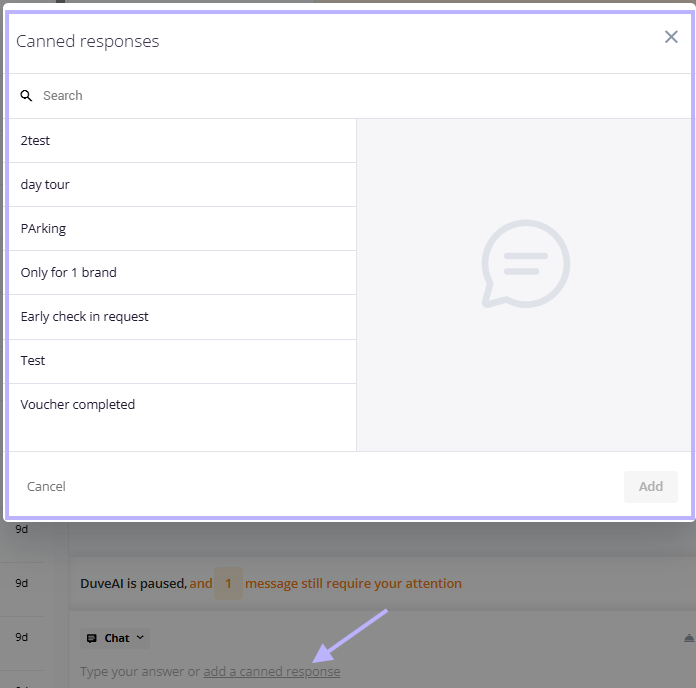
Canned responses are pre-written answers to common questions that your team can pick and send instead of retyping. To use one, click "Add a canned response" in the text box, or click the "+" and then choose an existing canned response or create a new one. The text appears in the message box, where you can edit it before sending.
What the picker offers depends on the channel you selected:
- Chat and SMS: your canned responses.
- WhatsApp: your canned responses and your WhatsApp templates.
- Email: your canned responses and the custom emails created in Scheduled Messages or the Pre Check-in Email Editor.
- Airbnb, Booking.com, Expedia Group, and WeChat: the canned responses available for that channel, and for WeChat, its own templates.
Troubleshooting note: Creating and editing canned responses is controlled by the "Edit canned responses" permission. Users without it can still send existing canned responses.
Rewriting a message with AI
After you have written at least two words, you can ask AI to rewrite the message for you before it goes out. The original text is kept, so you can undo the rewrite and go back to exactly what you wrote. On WhatsApp, the rewrite respects the channel's character limit.

Suggested replies from AI
With Smart Reply enabled, Duve drafts a suggested reply based on your own content, and shows which sources it used. You can open the sources list to see each one and jump to it. Edit the draft before sending, or cancel it and write your own. Duve records whether a sent message came from a suggestion, so you can see how the AI is performing.
A conversation can also be assigned to the AI team member, in which case the AI answers the guest and raises the conversation for a human when it needs attention. Where an Auto-Answer exception rule matches the conversation, the AI stops answering and only suggests replies, and the conversation shows a note saying so. When the AI has raised messages for attention, the conversation shows how many are waiting, and you can resolve them together.
Auto translation
Auto translation lets you and the guest write in your own languages. In the conversation, you can:
- Turn translation on or off for the guest's preferred language, which then applies to every guest who uses that language.
- Switch between the guest's original messages a

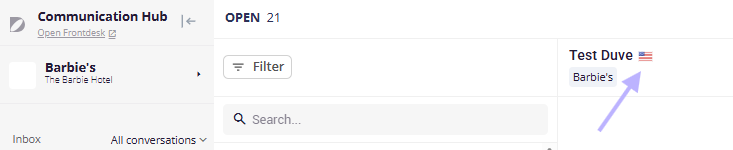
Troubleshooting note: The guest's preferred language is shown as a flag next to their name in the conversation header.
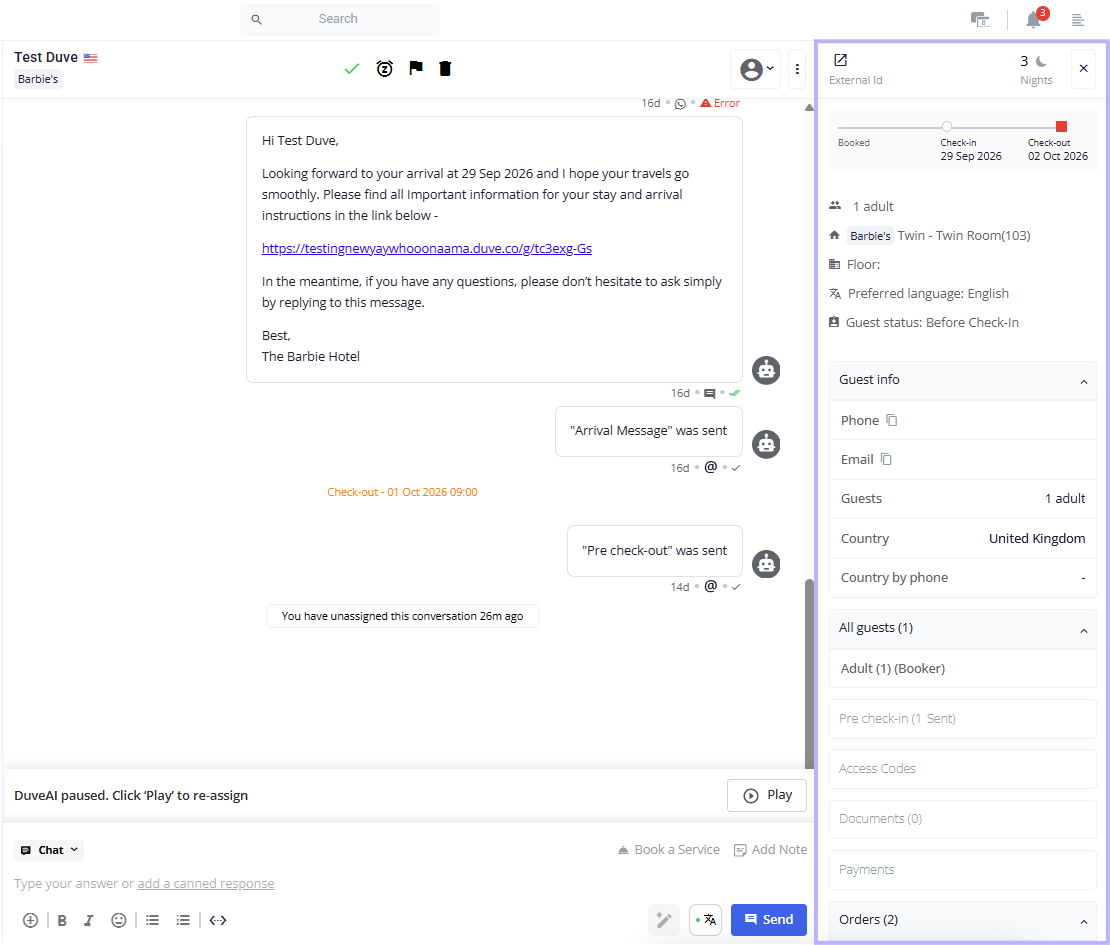
Guest and reservation details
The right-side panel holds everything you need about the guest and their stay, so you do not have to leave the conversation.
- The reservation details are listed first, including how many people are on the reservation (adults, children, and babies), the room or rental, the floor, the guest's preferred language, and the reservation status.
- Click the External ID icon to open the reservation page in a new tab. The number of nights appears next to the moon icon.
- The timeline highlights where the guest is between the day of booking and check-out.
- Expandable sections cover Guest Info, All guests, Pre check-in, Codes, Mobile keys, Documents, Payments, Orders, Assigned team members, Notes, Pre check-out, and Reservation Logs.
- Open "Reservation Logs" to see the log entries related to the communication with this guest.
- For a conversation that has no reservation attached, the panel shows the guest instead, with their contact information and all of their reservations.
- Collapse and expand the panel with the button in the conversation header. Duve remembers your choice.
Quick Actions
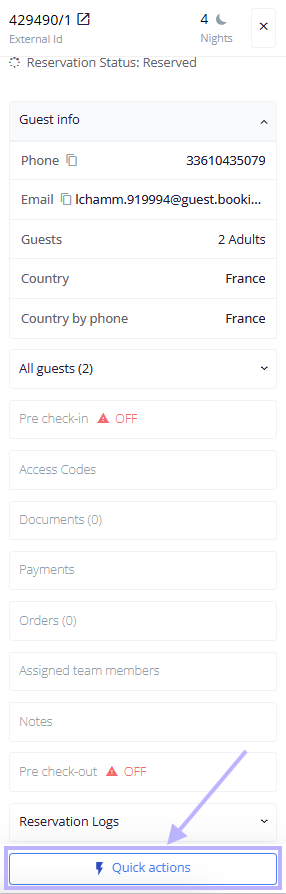
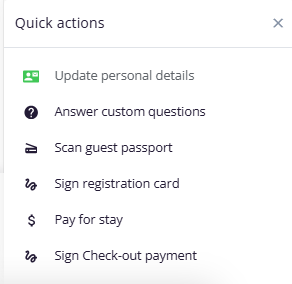
Quick Actions is a tool your team can use to help complete the remaining steps in the guest's journey. Click "Quick Actions" to see the steps that have not been completed yet. Select one and a tab opens on that step, where the guest can finish it in person. Steps that are already done are marked, so you can see progress at a glance. Where available, "Send to device" pushes the step to the guest's own device instead of completing it at the desk.
Internal notes
Internal notes let you flag an issue or highlight part of a conversation for your team. Guests never see notes. Click "Add note" at the top of the text box. The box turns orange and the send button changes to "Add".

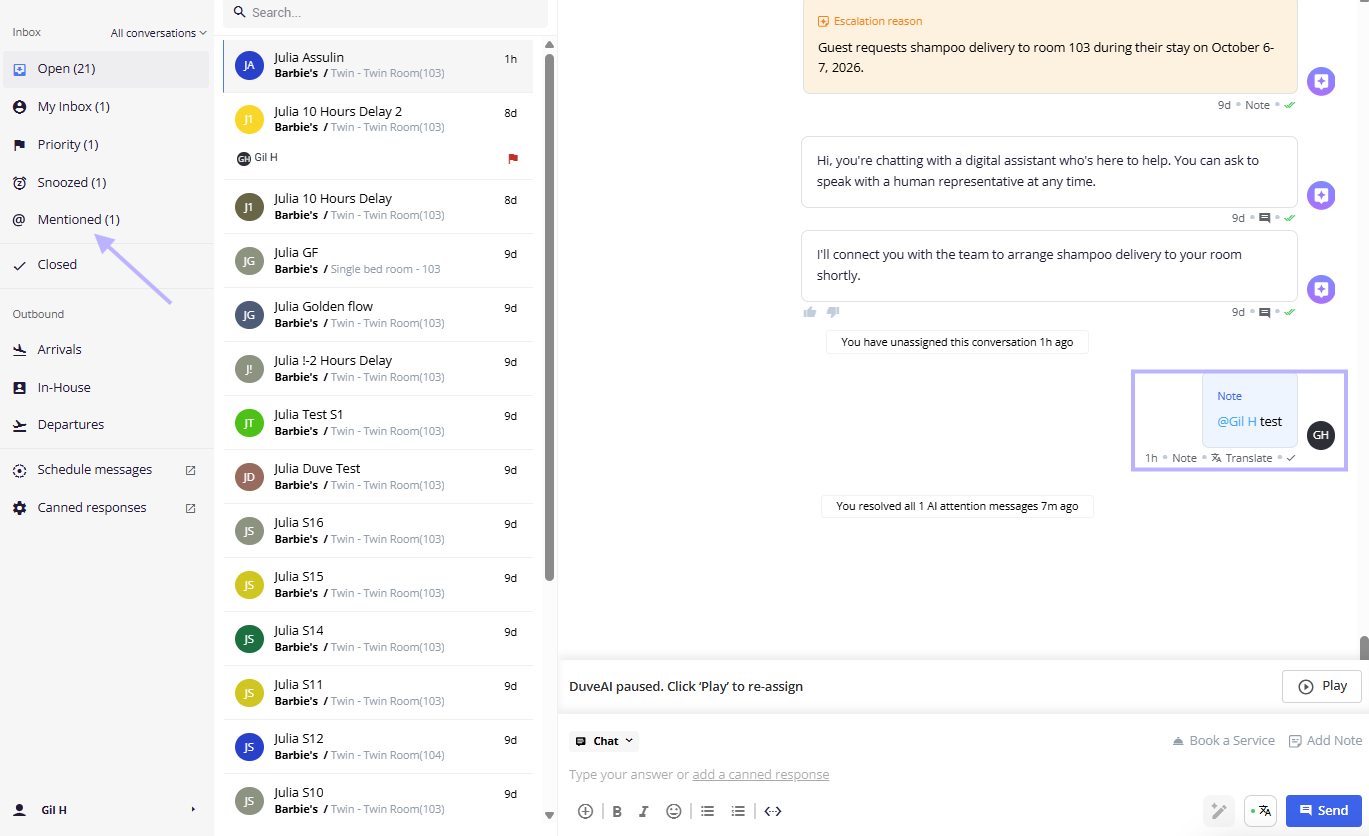
Mentioning a team member
Mentions are how you pull a colleague into a conversation. Type the @ symbol followed by the start of their username, then pick them from the list. Typing @ on its own switches the box into an internal note, so a mention is never visible to the guest.
The person you mention gets a notification, and the conversation appears in their "Mentioned" folder. Once you have dealt with it, use "Clear from mention" in the conversation menu to take it out of your own Mentioned folder.
Assigning a conversation
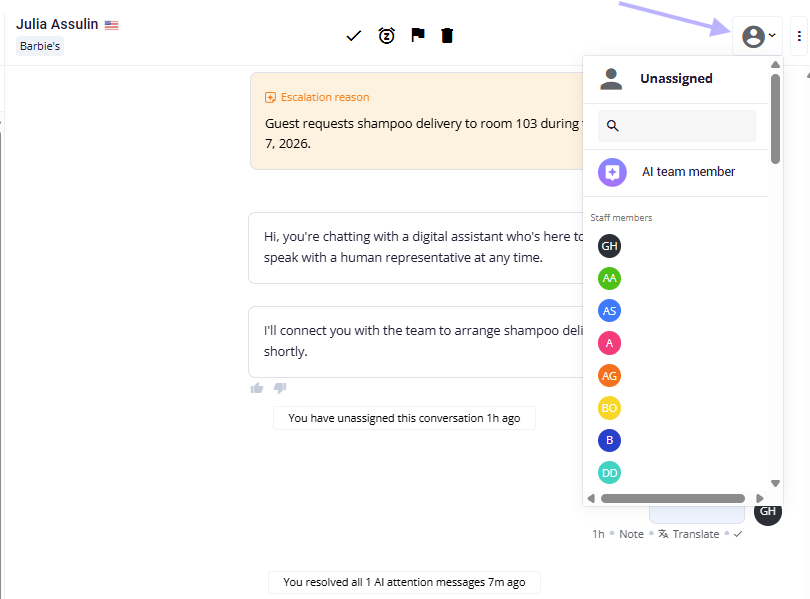
Open the assignment menu in the conversation header and choose who owns the conversation. You can search the list.
- Unassigned.
- The AI team member, when Smart Reply is enabled.
- A staff member. Only users who have access to chat are offered.
- A team. Account-level teams are offered on every conversation, and a brand team only on conversations belonging to its brand.
Once assigned, the conversation appears in that person's "My Inbox", or in the "My Inbox" of everyone on that team. The person or team assigned is notified.
Closing, snoozing, and prioritizing
- Close. After a conversation is resolved, mark it closed to clear your inbox. Closed conversations stay in the "Closed" folder for 14 days after they were closed, and can be reopened from there.
- Snooze. Snoozing takes a conversation out of your inbox and brings it back at a more relevant time, with a notification. Choose Later today, Tomorrow, Sunday, Monday, In one week, The day before check-in, or The day before check-out. Unsnooze brings it back immediately. For example, if a guest asks a week before arrival for something to be ready on check-in day, snooze the conversation until the day before check-in so it reminds you when it matters.
- Priority. Flag a conversation so it is easy to keep track of. It appears under the "Priority" folder. With Smart Priority enabled, you choose a level, Low, Medium, or High - each with its own color - and you can also sort the inbox by priority. Without Smart Priority, the flag is a single on-or-off state.

AI priority
With Smart Priority enabled, Duve reads each incoming guest message and can raise or lower the conversation's priority on its own. The conversation feed shows what the AI changed, and hovering over the information icon explains why, with three signals:
- Sentiment, from extremely negative through neutral to extremely positive.
- Topic, for example, emergencies, access issues, safety and security, housekeeping, technical malfunctions, payment issues, or transportation.
- Guest journey stage, from pre-arrival through arrival day, during stay, and departure day, to post-departure.
Note: Use the thumbs up and thumbs down icons on that entry to tell Duve whether the AI got it right.
The conversation menu
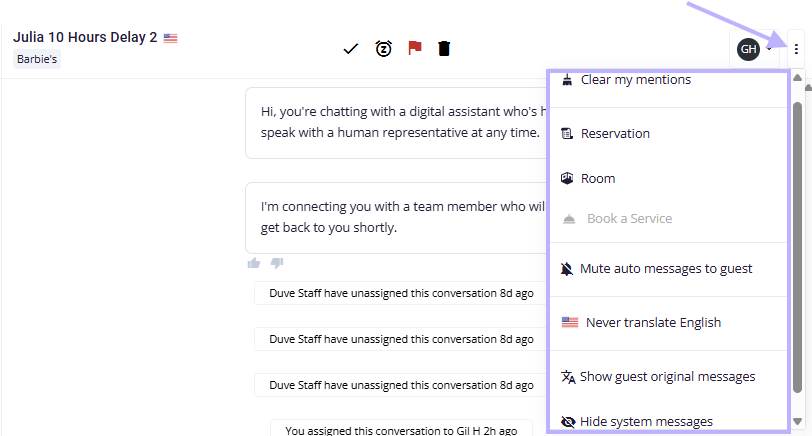
Open the three vertical dots icon in the conversation header for the rest of the options:
- Clear from mention, when you have been mentioned in this conversation.
- Reservation, which opens the reservation page.
- Room or Property, which opens the allocated room or rental page.
- Book a service, where front desk upsells are available on your account.
- Mute or unmute auto messages to the guest. Muting asks whether it should apply to this reservation period only, or permanently to the guest's profile. The permanent option is only offered where the guest is linked to a guest profile, and it also mutes the current stay.
- Translate, or never translate, the guest's preferred language.
- Show guest original messages, or show them translated.
- Hide or show system messages, which are the log entries for messages Duve sent automatically.
Broadcast messaging and filters
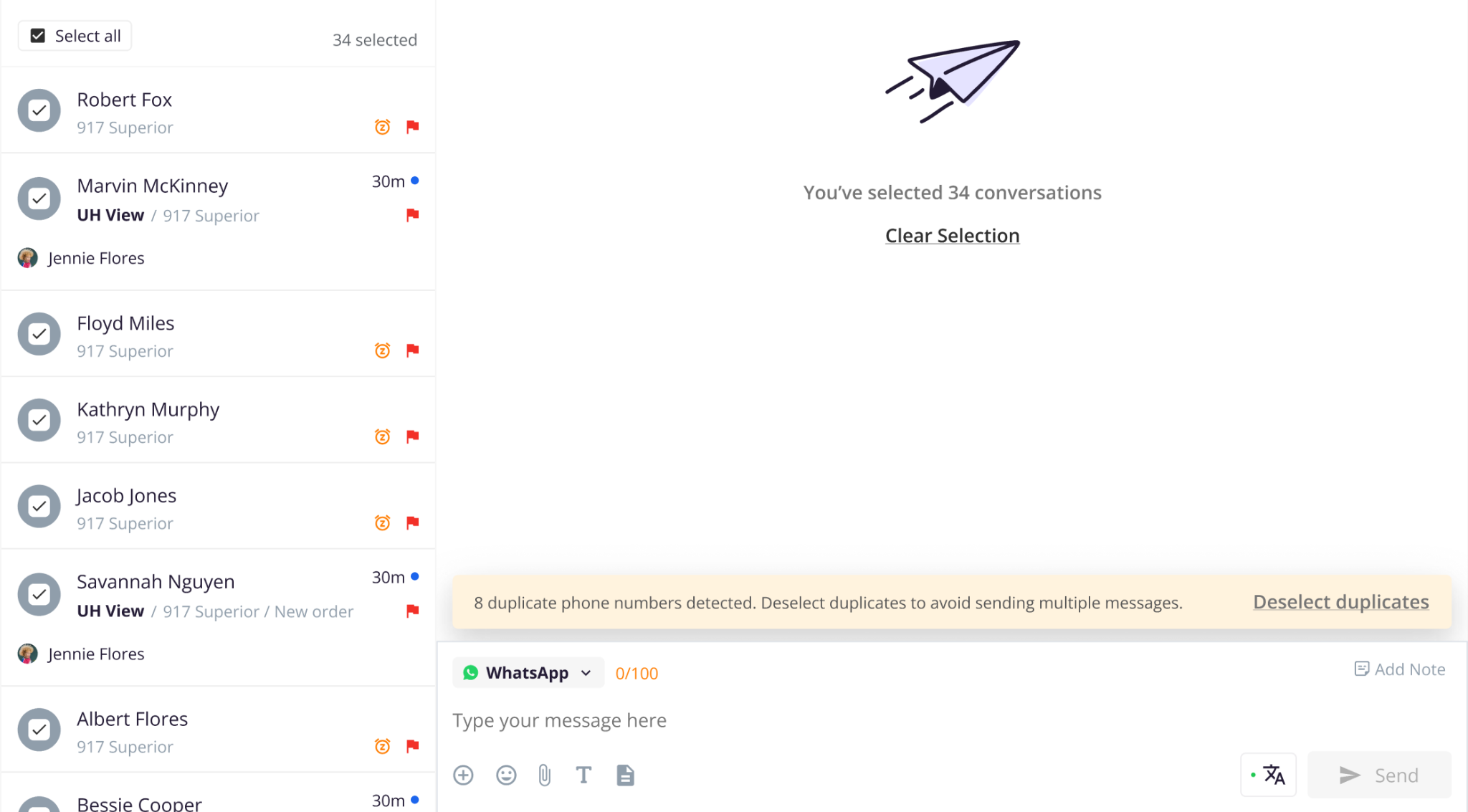
The Communication Hub lets you send one message to a group of guests. Select the conversations you want using the smart filters, for example Arrivals, In-House, or Departures, a single day or a date range, and any of the list filters. The header then shows how many conversations are selected, and what you type goes to all of them.
Before you send, Duve warns you about recipients who cannot receive the message:
- Guests with no valid phone number, who receive your message via chat instead.
- Guests with no valid email address, who will not receive your message.
- Duplicate phone numbers or email addresses, so the same person is not messaged twice. You can deselect the duplicates in one click.
Conversations without a reservation
Some conversations arrive before Duve can attach them to a reservation, for example, an anonymous WhatsApp from an unknown number, or an OTA inquiry. These are grouped so your team can pick them up, and the side panel shows the guest rather than a stay. Where Duve finds a likely reservation for that guest, the conversation header offers the possible match so you can confirm it and pull the reservation context in.
Anonymous Chat is a paid add-on.
Brands
On an account with several brands, the conversation header shows which brand the conversation belongs to. Canned responses, teams, and staff offered on a conversation are limited to that brand, and AI settings can be overridden per brand.
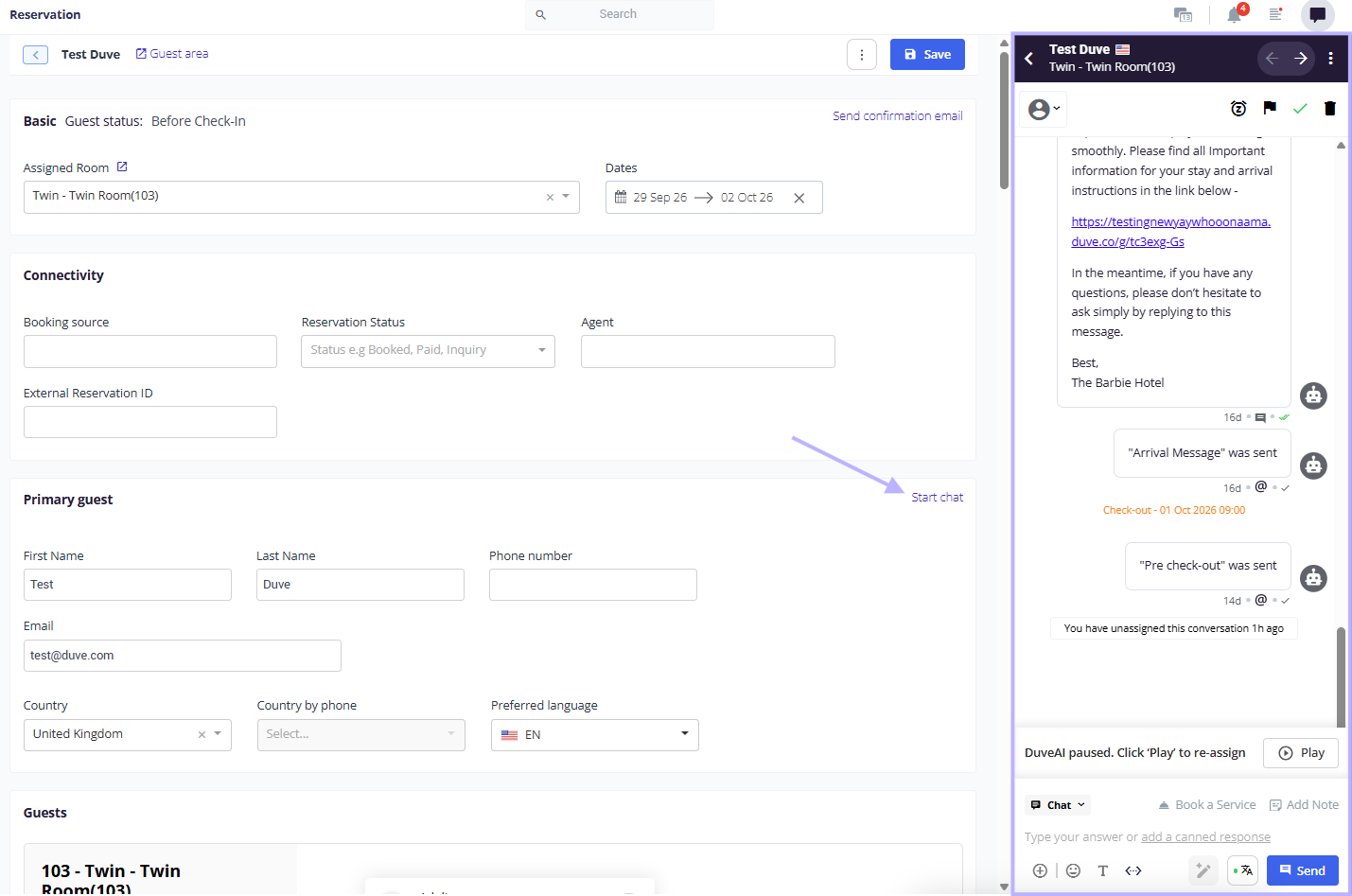
Communication Hub inside a reservation page
The Communication Hub is also available from within a reservation. Open the reservation and click "Start Chat" to see the whole history of messages with that guest and reply from there. The same conversation menu is available from the three vertical dots icon.
Guest experience
- A message sent on Chat appears in the guest's Guest app, in the Chat section.
- If the guest does not open it in the Guest app within 3 minutes, the same message reaches them by email, with a button that opens the chat in the Guest app. That button is not shown after the maximum check-out time has passed.
- Messages are translated into the guest's preferred language when auto-translation is on, and attachments the guest receives are included in the email.
- On WhatsApp, a template can include a "View Messages" button. When the guest taps it, a WhatsApp session opens, and the conversation feed records that the guest did so, which tells your team free text is available again.
- Guests never see internal notes, mentions, priority levels, snooze, or assignment.
- Where a file type cannot be stored, the conversation shows that the guest sent an unsupported attachment rather than the file.
Troubleshooting
- The guest is not receiving SMS: Check that the reservation has a valid phone number and that SMS billing is enabled on your account. The message box tells you when the number is not valid.
- The guest is not receiving email: Check that the reservation has a valid email address. Email delivery status is tracked, and a message can show as pending, delivered, failed, bounced, or complained.
- You can only send a WhatsApp template: More than 24 hours have passed since the guest's last WhatsApp message, so the session is closed. Send an approved template or a "Free text" message to reopen it.
- The AI is not answering a conversation it normally handles: Check whether the conversation is assigned to the AI team member, and whether an Auto-Answer exception rule matched it. Where a rule matched, the AI only suggests replies and the conversation shows a note.
- A conversation disappeared from Open: It was closed or snoozed. Look in the "Closed" or "Snoozed" folder.
- A colleague cannot see a conversation you assigned to them: Check that they have the "Access chat" permission, and that the conversation's brand is one they work on.
Restrictions and limitations
- Closed conversations are available in the "Closed" folder for 14 days after they were closed.
- WhatsApp free text is only possible within 24 hours of the guest's last WhatsApp message. Outside that window, you can only send an approved template.
- AI rewrite needs at least two words in the message box before it will run.
- A conversation can be assigned to one person, one team, or the AI team member, not to several at once.
- Permanent mute is only available where the guest is linked to a guest profile. Otherwise, muting applies to the reservation period.
- OTA channels are limited by what each OTA allows in its own inbox.
- Basic plan accounts cannot send from the Hub or use the conversation actions.
Tips and tricks
- Save the filters your shift uses every day, so switching context takes one click rather than rebuilding the filter each time.
- Assign to a team rather than to a person for anything that has to survive a shift change.
- Snooze to the day before check-in for any request that is only actionable on arrival, instead of leaving it open in the inbox.
- Move through the inbox with the up and down arrow keys while you triage.
- Use "Clear from mention" once you have handled a mention, so your Mentioned folder reflects real outstanding work.
- Turn off translation for the languages your team speaks, so those conversations stay in the original wording.
- Give the AI priority a thumbs up or thumbs down. The feedback is recorded and shows where the signal needs work.
FAQs
Q: Which channels can the Communication Hub handle?
A: Guest app Chat, SMS, WhatsApp, Email, WeChat, your PMS where a two-way messaging connection exists, and the OTA inboxes of Airbnb, Booking.com, and Expedia Group.
Q: What happens if the guest never opens a chat message in the Guest app?
A: If they do not view it in the Guest app within 3 minutes, the message is sent to them by email instead, with a button to open the chat.
Q: How long do closed conversations stay accessible?
A: They stay in the "Closed" folder for 14 days after the conversation was closed, and can be reopened from there.
Q: Can I assign a conversation to a whole team?
A: Yes. Alongside individual staff members, the assignment menu lists your user teams. Assigning to a team puts the conversation in "My Inbox" for everyone on it. Teams created under a brand are only offered on that brand's conversations.
Q: Can the AI answer guests for me?
A: With Smart Reply enabled, yes. Assign the conversation to the AI team member and it answers the guest, raising messages for a human when they need attention. If an Auto-Answer exception rule matches the conversation, the AI only suggests replies instead.
Q: Do guests see internal notes or mentions?
A: No. Notes and mentions are visible only to users on your account.
Q: Why can I only send a WhatsApp template to some guests?
A: WhatsApp allows free text only while a session is open. If the guest has not written to you on WhatsApp in the last 24 hours, or has never written, you send an approved template first.
Q: Can I undo an AI rewrite of my message?
A: Yes. Your original text is kept, so you can revert to exactly what you wrote before the rewrite.
Q: How many priority levels are there?
A: With Smart Priority enabled, there are three: Low, Medium, and High, each with its own color, and you can sort the inbox by priority. Without Smart Priority, priority is a single flag that is either on or off.
Q: Who can see the Communication Hub?
A: Users with the "Access chat" permission. Manager, Agent, and Staff roles have it by default, and it can be removed per user. Supplier users do not have access.
Q: Which plan do I need?
A: Pro or Premium, or the Communication Hub Only or Communication Hub + Guest App packages. Smart Priority, Smart Reply, and Anonymous Chat are paid add-ons on top of the plan.
Q: Can I message a group of guests at once?
A: Yes. Filter and select the conversations you want, then type once. Duve warns you about recipients with no valid phone or email, and about duplicates, before you send.
Q: What are the conversations without a reservation?
A: Messages that arrived before Duve could match them to a stay, such as an anonymous WhatsApp or SMS message or an OTA inquiry. Where Duve finds a likely reservation for that guest, the conversation header offers the match so you can confirm it. This is part of the Anonymous Chat add-on.
Q: A user is not seeing the purple dots and flags in the communication hub for message priority or new messages. Their permission is manager, and they have no restrictions. How to troubleshoot?
A: The user should clear their cache in their browser and restart Duve. This should work to ensure that the new messages icon and message priority flag are shown on each conversation.
Q: Can I stop Duve's automatic messages to one guest?
A: Yes. Use the mute option in the conversation menu, and choose whether it applies to this reservation period or permanently to the guest's profile. The permanent option is only offered where the guest is linked to a guest profile.
Q: What does 'New Chat Message email failed to x' log error mean?
A: If you are seeing this error, it means that your account's domain verification has not been verified. Please remove the domain verification from the account and complete it again; your company's IT team should be aware of how to complete the setup. For further instructions, please see: Domain Verification
Q: Can a host send attachments to guests and vice versa?
A:
| SMS | Chat | |||
| Pictures/Files from Guest to Host (Host=Duve ComHub) | Yes | No | Yes | Yes |
| Pictures/Files from Host to Guest (from ComHub) | Yes - from Both | No - from neither | Yes - from Both | Yes - from Both |
Comments
0 comments
Article is closed for comments.