
Overview
Room Upgrade Multi-Product Management lets you create multiple room upgrade products under the same brand, rather than a single catalog that every arriving guest sees.
Each product is configured independently: its own name, description, associated room types, upgrade levels, pricing, payment method, availability, extra pricing campaigns, and targeting conditions. Each product can also be enabled or disabled individually.
Duve evaluates every active room upgrade product against the guest's reservation and displays exactly one of them. Guests only see the upgrade options that belong to the product they qualify for, so incompatible room types (for example, female-only dorm beds offered to a male guest) are no longer part of the catalog they browse.

Applies to
|
Use cases
- Gender-specific inventory: a property running mixed-gender and female-only dormitory rooms builds one product for each guest segment, so no guest is offered a room type they cannot occupy.
- Loyalty or membership tiers: a premium catalog targeted at members, and a standard catalog for everyone else.
- Booking source segmentation: a different upgrade catalog for direct bookers than for OTA arrivals.
- Rate plan or room type segmentation: suite upgrades offered only to guests already booked into higher categories.
- Seasonal campaigns: a summer catalog and a winter catalog created once, then activated or deactivated as needed instead of being rebuilt or deleted.
- Testing a new catalog: duplicate a live product, adjust it while it is disabled, then enable it when you are ready.
Before you start
- Confirm your room types are set up and synced, and that pricing exists for the upgrade paths you want to sell.
- Decide which guest segment each product should serve, and which existing Duve condition expresses that segment (for example booking source, membership, room type, rate plan, or a custom check-in question).
- Note that only one product is ever shown to a guest. Plan your conditions so that the intended product is the one that wins, and read the precedence rules below before building overlapping catalogs.
- Existing setups need no migration. If your brand has a single room upgrade product today, it continues to behave exactly as before.
How to set it up
Create an additional room upgrade product
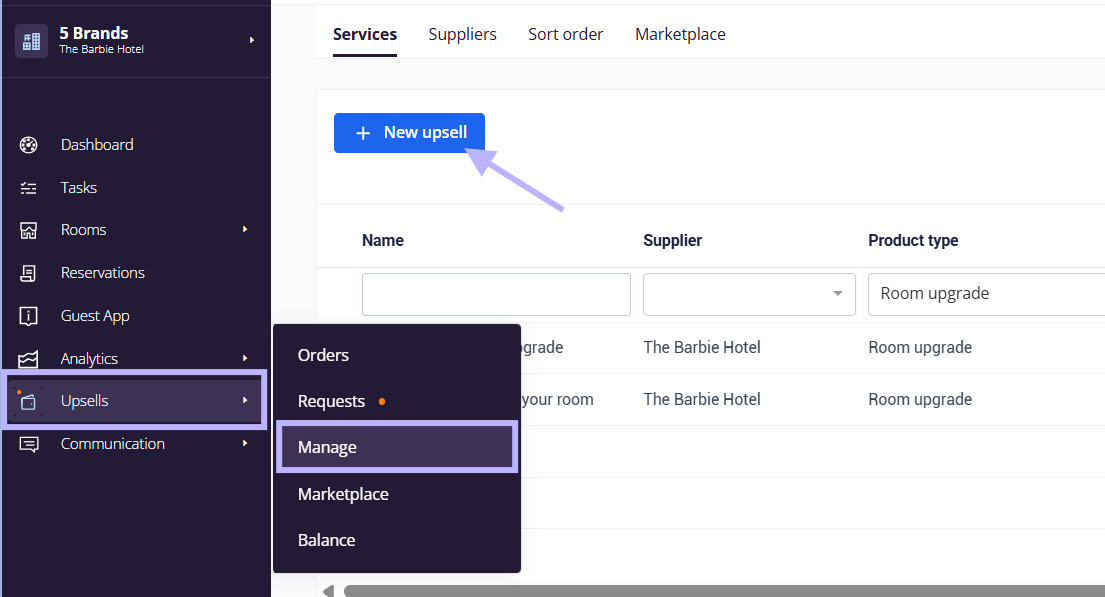
- Go to Upsells and open the Manage tab (will open the Services list).
Click on +New upsell, then choose Room Upgrade. The option is no longer hidden once a brand already has a room upgrade product.
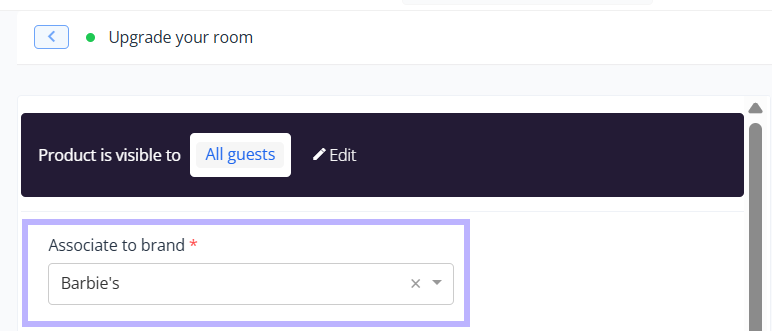
In the product page, use the Associate to brand selector to pick the brand. Every brand on the account is listed, including brands that already carry another room upgrade product.
- Fill in the product name and description, then configure the sections below it: Booking Options, Room Types, Price Levels, Default Pricing, Payment Method (all listed until here are mandatory fields), Availability, Discounts, Extra Pricing, Additional charges and Advanced Options.
- Click Save. You are asked whether to save and enable, or save without enabling.
Target a product at a specific guest segment
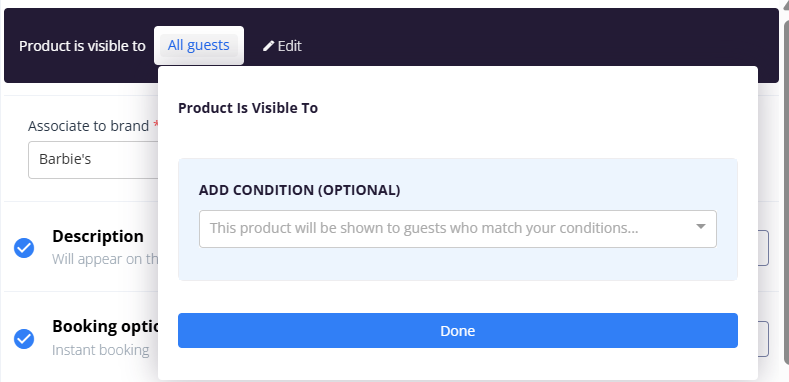
- Open the product and use the Filter by section at the top of the page.
- Add the conditions that describe the guests this catalog is for.
- Save the product.
Troubleshooting note: A guest who does not match a product's conditions is simply not offered that product. Other active products are still evaluated, so a non-matching product no longer suppresses the upgrade offer entirely.
Understand which product a guest sees
When a guest reaches the upgrade screen, Duve evaluates all active room upgrade products for the brand against that reservation and displays one:
- Products whose conditions or rules do not match the reservation are eliminated.
- Products with no available, priced room type above the guest's current room are eliminated.
- Among the products that remain, Duve compares the first upgrade level the guest can actually book, and takes the most expensive option in that level.
- The product with the highest such price wins and is the only one rendered.
- If two products tie, the one created earlier wins. If they were created at the same time, the tie is settled on the internal product ID, so the outcome is always deterministic.
- For a bidding product, the comparison uses the default bid Duve shows the guest, not the minimum bid. This prevents a wide bidding range from being ranked at its floor and losing to a cheaper fixed-price product.
- If no product matches, the upgrade screen is skipped, and no upgrade is offered.
Troubleshooting note: The guest orders from the product that was displayed to them, so pricing and approval settings always come from the catalog they actually saw.
Duplicate a product
- Open the product you want to copy.
Open the ••• icon action menu in the page header and choose Duplicate.
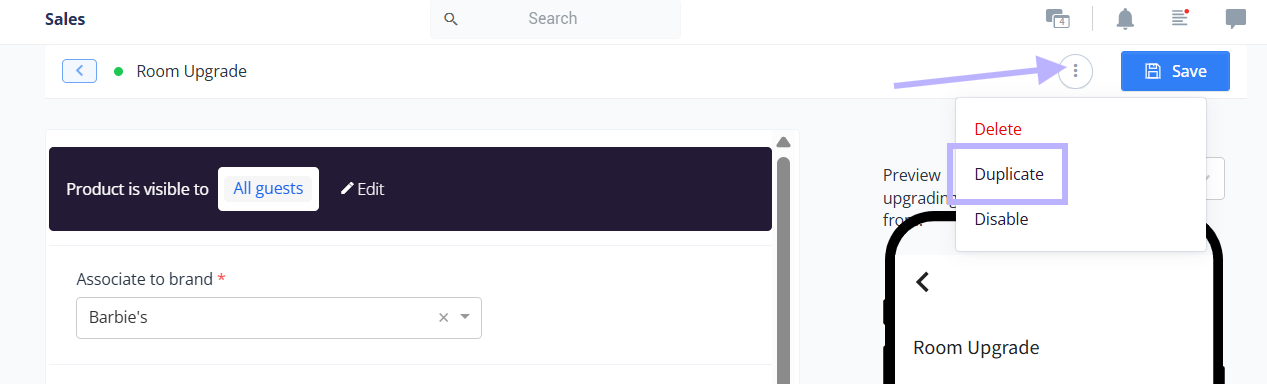
- Duve creates a copy named after the source with
(Copy)appended and opens it.
Troubleshooting note: The duplicate includes the source product's settings, the full price matrix, extra pricing campaigns, and translations. It is created disabled because it shares the source's brand and room types and would otherwise compete with the original for real guests immediately. Rename it, adjust it, add its conditions, then enable it.
Activate or deactivate a product
- Open the product and use the ••• icon action menu to choose Enable or Disable.
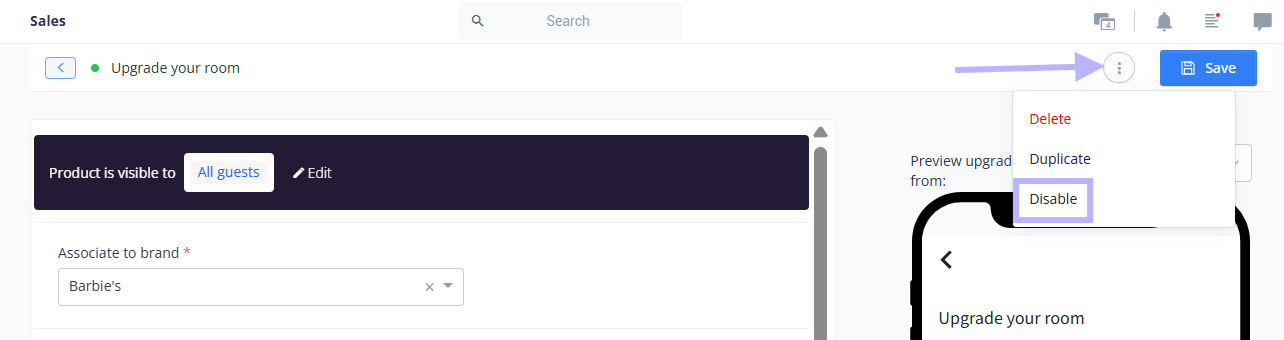
- A disabled product keeps all of its configuration and is never evaluated for guests, which makes it suitable for seasonal or time-limited campaigns.
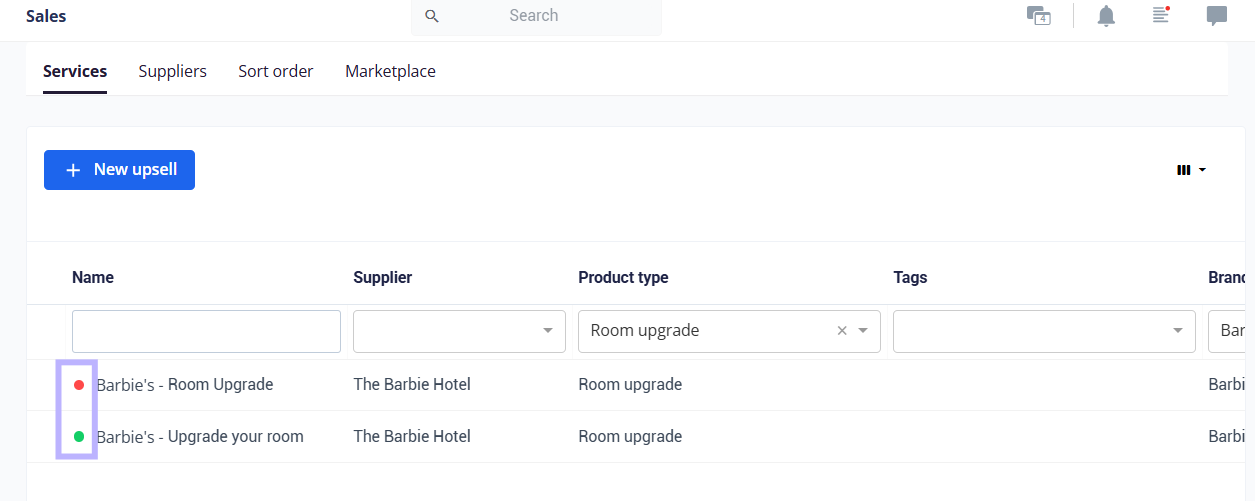
- The colored dot next to the product name in the page header indicates whether the product is currently enabled: Red for a disabled product, Green for an enabled product
Troubleshooting
- A guest sees no upgrade offer at all: no active product matched that reservation. Check each product's conditions, rules, availability settings, and whether priced upgrade options exist above the guest's booked room type.
- The wrong catalog is displayed: more than one product matched, and the one shown is the one whose first bookable upgrade level costs the most. Tighten the conditions on the product that should not have matched, or adjust the price levels.
- A guest is offered room types they should not see: the winning product's associated room types include those rooms. Move them to a separate product with its own conditions.
Restrictions & Limitations
- Only one room upgrade product is ever shown to a guest. There is no combined view across products, and there is no fallback to an unfiltered catalog.
- A duplicated product is always created disabled and must be enabled manually.
- Changing the brand on a product clears its associated room types, price levels, and inventory limits, because room types belong to the brand.
- A guest who already has a room upgrade order stays pinned to the product they ordered from, even if you later add conditions that would exclude them. This is intentional, so a paid order is never hidden by a later targeting change.
- Ranking uses the price shown to the guest. For products priced as a percentage of accommodation and combined with extra pricing, the ranking price can differ from the final charged price.
Tips & Tricks
- Build the narrow, segment-specific catalog as its own product and keep a broad catalog as the general case. Guests who match the narrow one see it, and everyone else falls through to the broad one.
- Use Duplicate as the starting point for a segmented catalog. Copying an existing product and then removing the room types that do not apply is faster than building from scratch, and the price matrix comes with it.
- Give products names that describe their audience, for example "Suite upgrade, female-only dorms" or "Members, high season". The product name is what you see in the Services list.
- If a campaign ends, disable the product instead of deleting it. All pricing and translations are preserved for the next season.
FAQs
Q: How many room upgrade products can I create under one brand?
A: There is no longer a per-brand cap. You can create as many as you need, and each is configured and activated independently.
Q: What happens to my existing room upgrade product?
A: Nothing. Single-product setups continue to work exactly as before, with no migration step and no data loss.
Q: Can a guest see two upgrade catalogs at once?
A: No. Duve evaluates all active products and displays exactly one, so the guest browses a single catalog.
Q: How do I control which product wins when a guest matches more than one?
A: Precedence is automatic. Duve compares the most expensive option in the first upgrade level each guest can book, and shows the product with the highest one. To control the outcome, use conditions so that only the intended product matches, or adjust your price levels.
Q: What happens if a guest matches no product?
A: The upgrade screen is skipped entirely. No unfiltered catalog is shown as a fallback.
Q: How does a bidding product compete with a fixed-price product?
A: The bidding product is compared using the default bid the guest is shown, not the minimum bid, so a bidding product is not unfairly ranked at its floor.
Q: Does the duplicate include pricing and translations?
A: Yes. The price matrix, extra pricing campaigns, and translations are copied. The duplicate is created disabled so it does not go live before you have adjusted it.
Q: Will a guest who already bought an upgrade lose it if I change targeting?
A: No. A guest with an existing room upgrade order stays with the product they ordered from, even if new conditions would otherwise exclude them.
Q: Does this work in the Guest App as well as Online Check-In?
A: Yes. Both surfaces evaluate the active products against the reservation and render the single winning product.
Q: Do I need to reorder products manually after adding a new one?
A: No. There is no manual ordering. Selection is decided at render time by conditions first, then by price.
Related article:
How to set up Room Upgrades
Comments
0 comments
Article is closed for comments.