
Overview
Staff Teams let you group the people who work in your property into named teams, such as Front Desk, Housekeeping, Concierge, Spa, or Maintenance, and then route a guest conversation to a whole team instead of to one named person.
Before Staff Teams, a conversation in the Communication Hub could only be assigned to a specific individual. That meant whoever routed the conversation had to know exactly who was on shift at that moment. With Staff Teams, you route to the department, every eligible member of that team is notified, and one of them takes ownership by assigning the conversation to themselves.
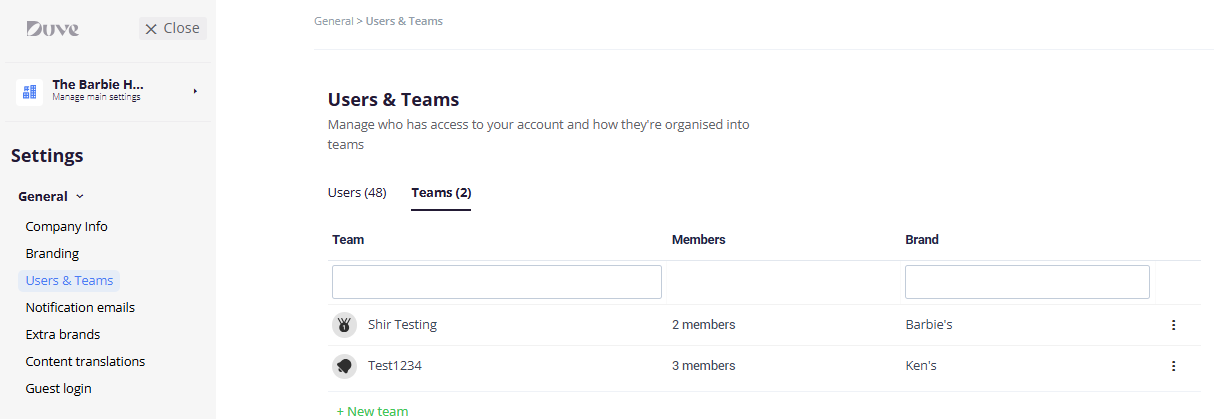
Teams are created and managed in Settings, under the page now named Users & Teams. Once a team exists, it appears as a routing target in the Communication Hub assign dropdown and as a recipient option in your unanswered-chat reminder alerts.
Who this is for
|
Use cases
- Structure your property by service area. A manager creates named teams like "Dining Reservations", "Concierge", or "Housekeeping" once, and updates the member list only when the roster changes.
- Route without knowing the shift schedule. A front desk agent receives a dining request and routes it to the "Dining Reservations" team, so the right group is alerted immediately regardless of who is currently on duty.
- Take clear ownership. A team member sees the conversation routed to their team, assigns it to themselves, and the rest of the team can see it is handled, which avoids two people replying to the same guest.
- Track accountability. A manager can see which staff member took over a team conversation, because the individual replaces the team as the assignee.
- Escalate reminders to a group. An unanswered-chat reminder alert can be sent to a whole team instead of a list of individuals, so nobody is missed when someone is off.
Before you start
- Decide which departments you want to represent as teams, and who belongs to each.
- Make sure the staff you want to add already exist as users in your Duve account. Only active, non-deleted users of your company can be added to a team.
- If you run multiple brands, decide whether each team should belong to a specific brand or sit at the account level, because that choice controls who can be added to it and who can see it.
- To create or change teams, you need the Manager role together with the View & edit company settings permission.
How to set it up
Create a team
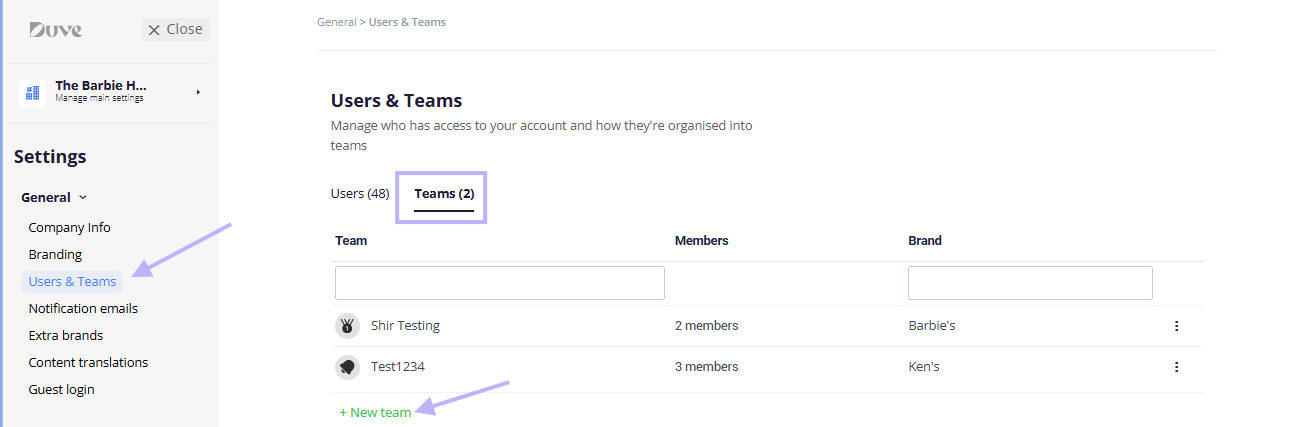
- Go to Settings › Users & Teams.
- Open the Teams tab.
-
Click + New team.
- Enter a Team Name. This field is required. Names can contain letters, numbers, and spaces only, up to 20 characters.
- Select an Icon. This is optional, and the first icon (People) is selected by default. There are 16 icons to choose from.
- Select a Brand. This is optional, and you can select only one brand. You can only pick brands you are associated with.
- Select Members. At least one member is required.
- Click Create team.
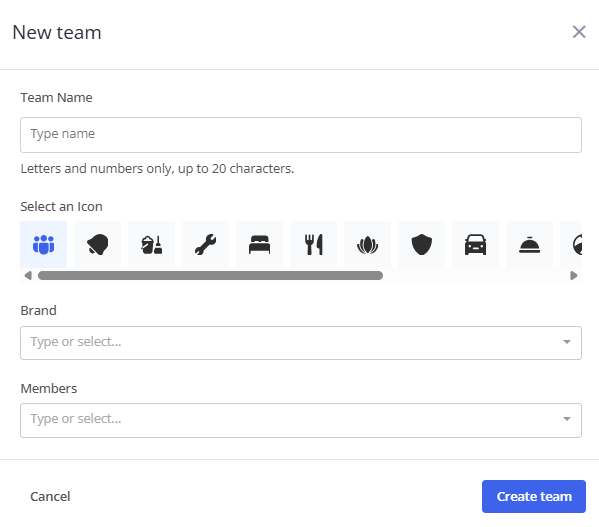
Troubleshooting note: The Create team button stays disabled until the required fields are filled in.
How the brand choice affects a team
- If you select a brand, the member dropdown offers users associated with that brand, and the team is visible to people whose permissions cover that brand.
- If you do not select a brand, the team is created at the account level and only account-level (unrestricted) users can be added to it.
- Team names must be unique within their scope. The same name can exist under two (or more) different brands, or once under a brand and once at the account level.
- A staff member can belong to more than one team.
- You can add yourself to a team you are creating or editing.
Edit a team
- Go to Settings › Users & Teams › Teams.
-
Click the team you want to change, or use the actions menu at the ••• icon and choose to edit it.
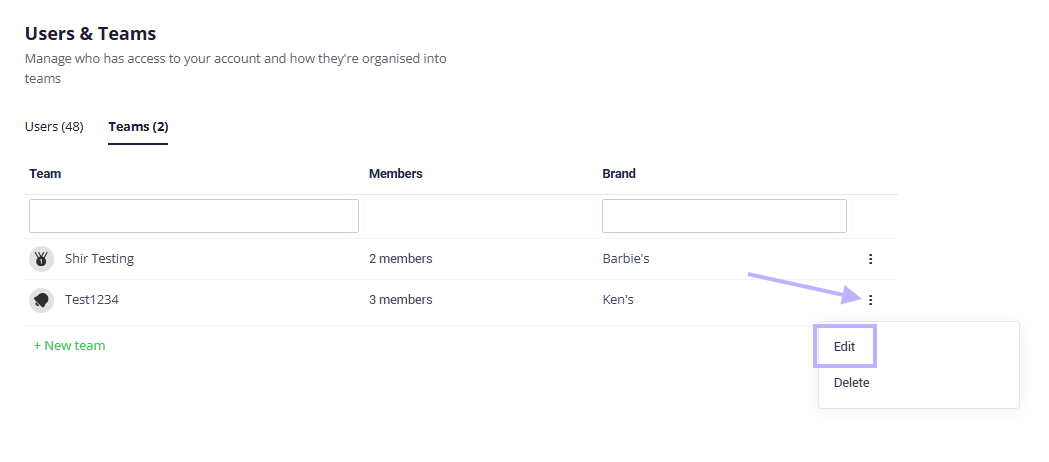
- Update the name, icon, brand, or members.
- Click Save.
Troubleshooting note: If you change the brand on an existing team, members who are not eligible for the new brand are removed from the selection.
Delete a team
- Go to Settings › Users & Teams › Teams.
-
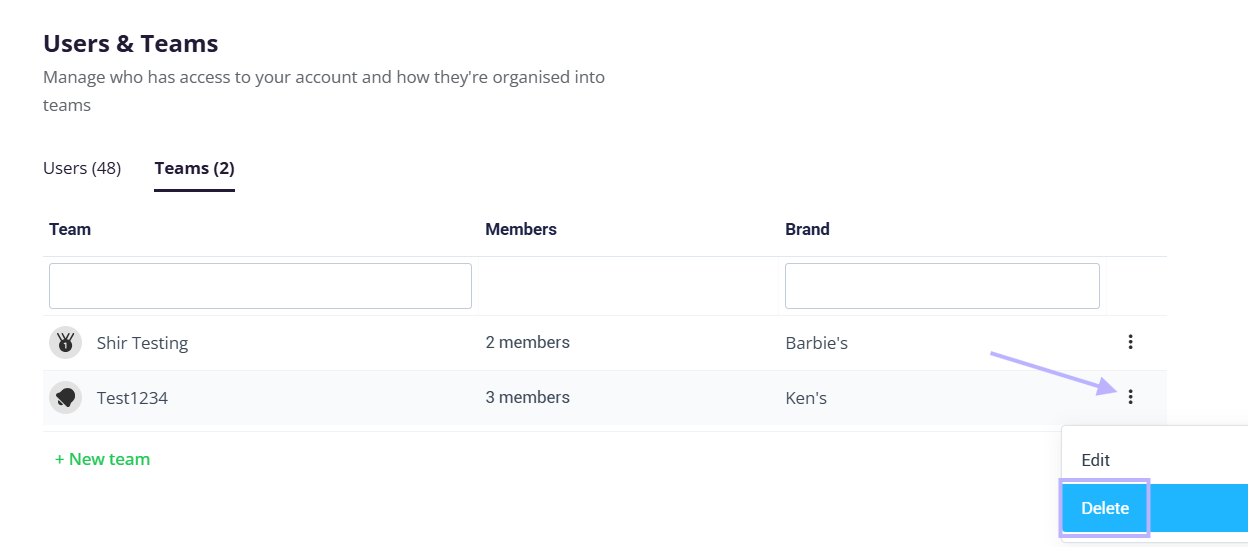
Open the actions menu at the ••• icon on the team row and choose to delete it.
-
Read the confirmation message, which tells you how many members will be removed and warns that open conversations assigned to the team will become unassigned.
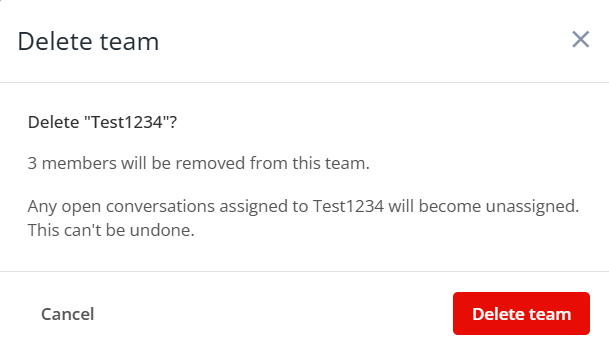
- Click Delete team.
Troubleshooting note: Deleting a team cannot be undone. Any open conversation that was assigned to that team is automatically unassigned.
Manage a user's teams from the Users tab
- The Users tab has a Teams column, which you can filter the same way you filter Brands and Tags.
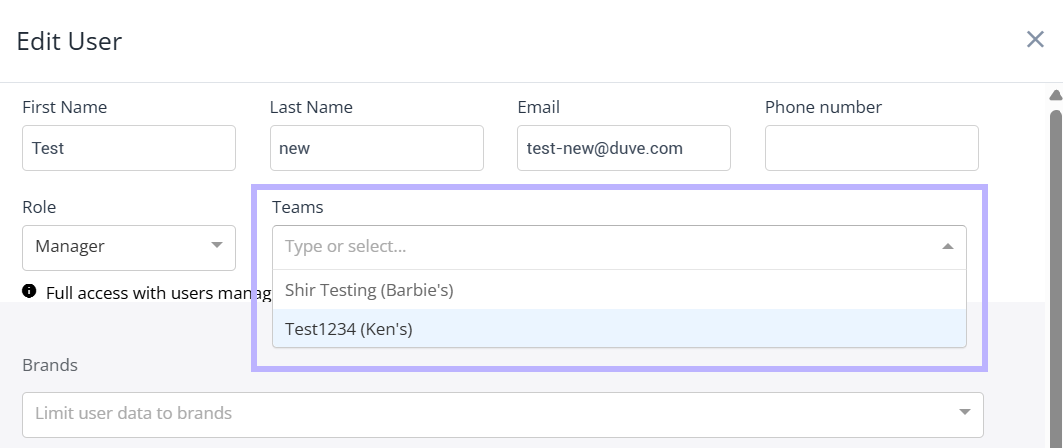
- Open a user to edit them, and use the Teams field next to Role to add or remove that user's team memberships.
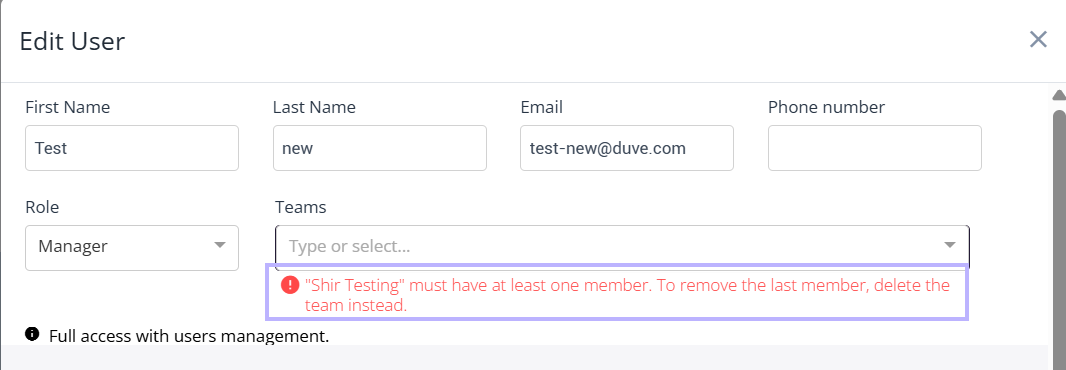
- You cannot remove the last remaining member of a team. If you try, an inline error appears. Add another member first, or delete the team instead.
See your own teams
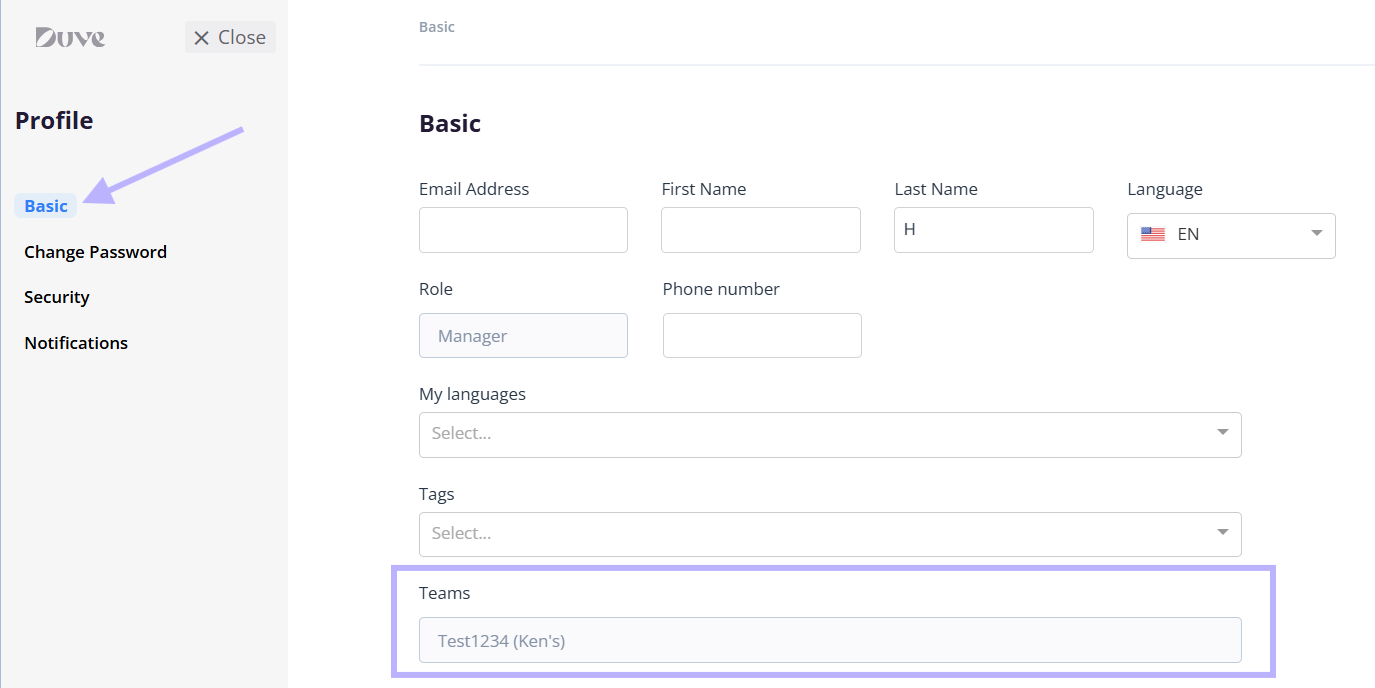
Your teams appear as a read-only field on your profile, under Profile › Basic, next to Tags. The field is hidden if you do not belong to any team. Membership can only be changed in Settings › Users & Teams.
How to use it
Route a conversation to a team
- Open the conversation in the Communication Hub.
- Click the assignee control at the top right of the conversation.
-
Use the search box to find a person or a team, or scroll to the Teams section below Staff members.
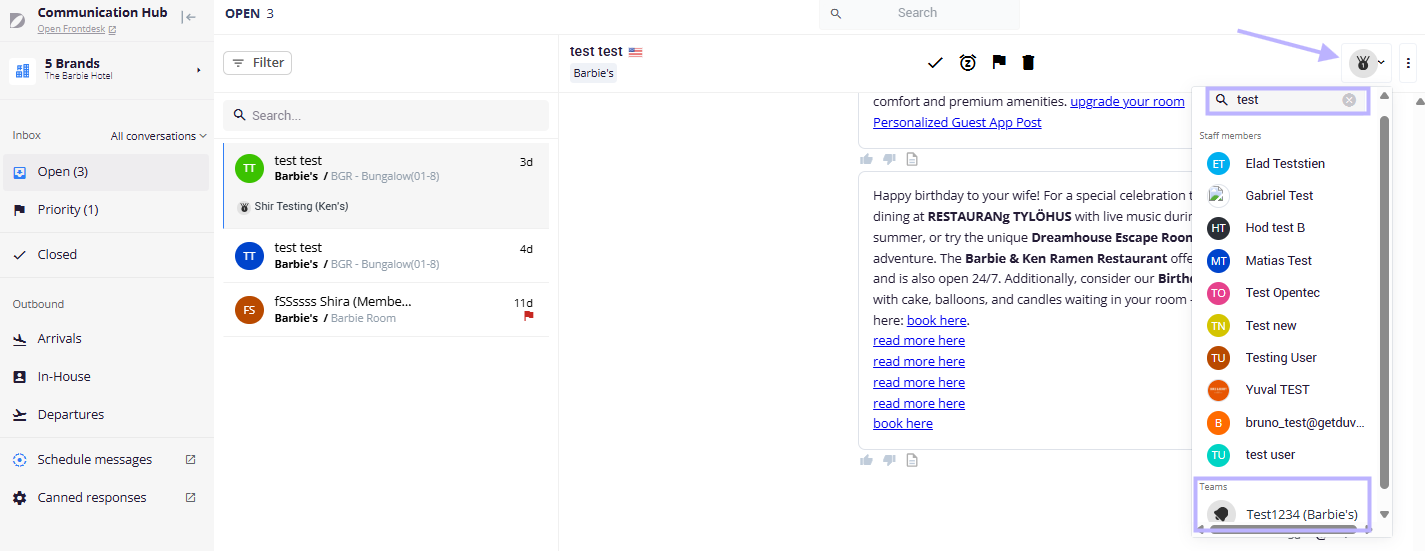
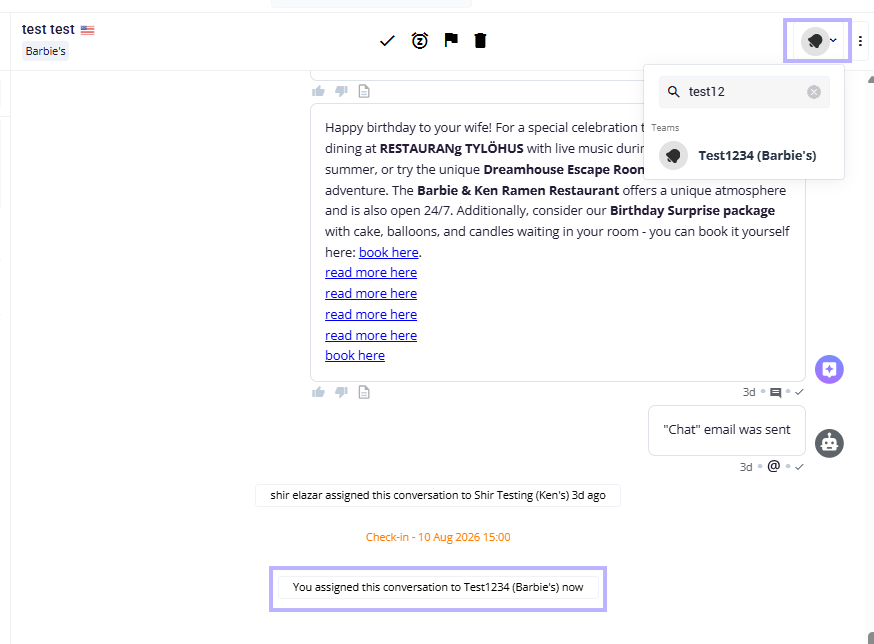
- Click the team you want.
Troubleshooting note: The assigned team is then shown on the conversation header and as a chip on the conversation row in the inbox list, and the assignment is recorded in the conversation event feed.
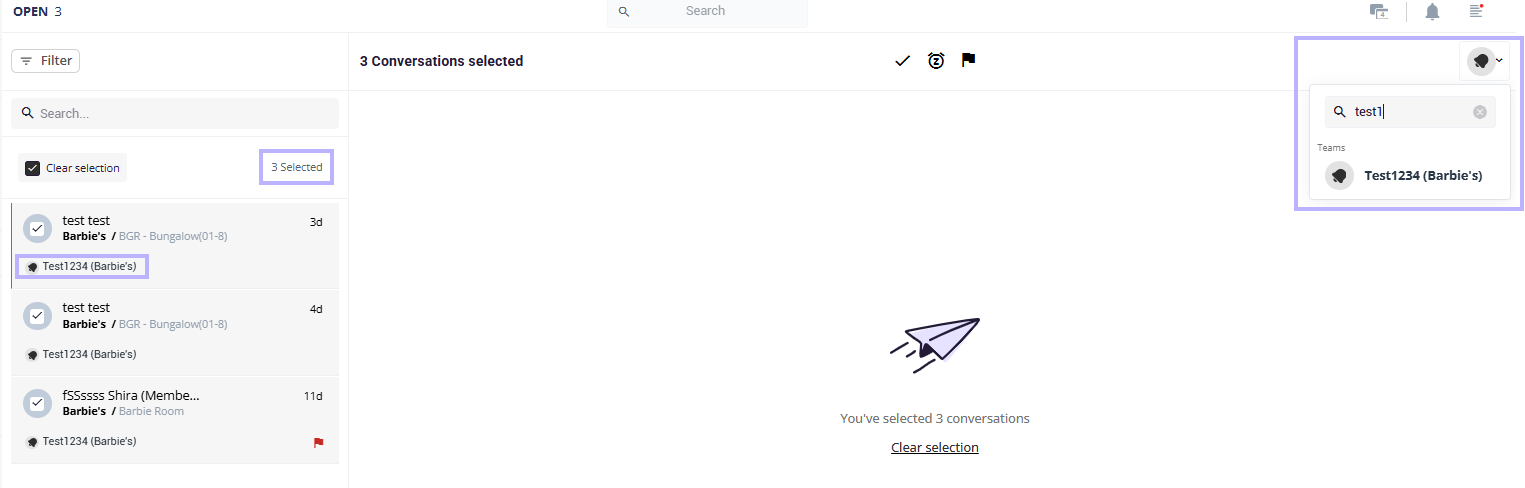
Troubleshooting note: You can also select several conversations in the inbox list and assign them to a team in one action.
Take ownership of a team conversation
Any member of the team can open the conversation and assign it to themselves from the same assignee control. Doing so replaces the team with that individual as the assignee, so the rest of the team can see the conversation now has a named owner.
Send staff reminder alerts to a team
-
Go to Settings › Communication > Unanswered Chats and find the Staff Reminders section.
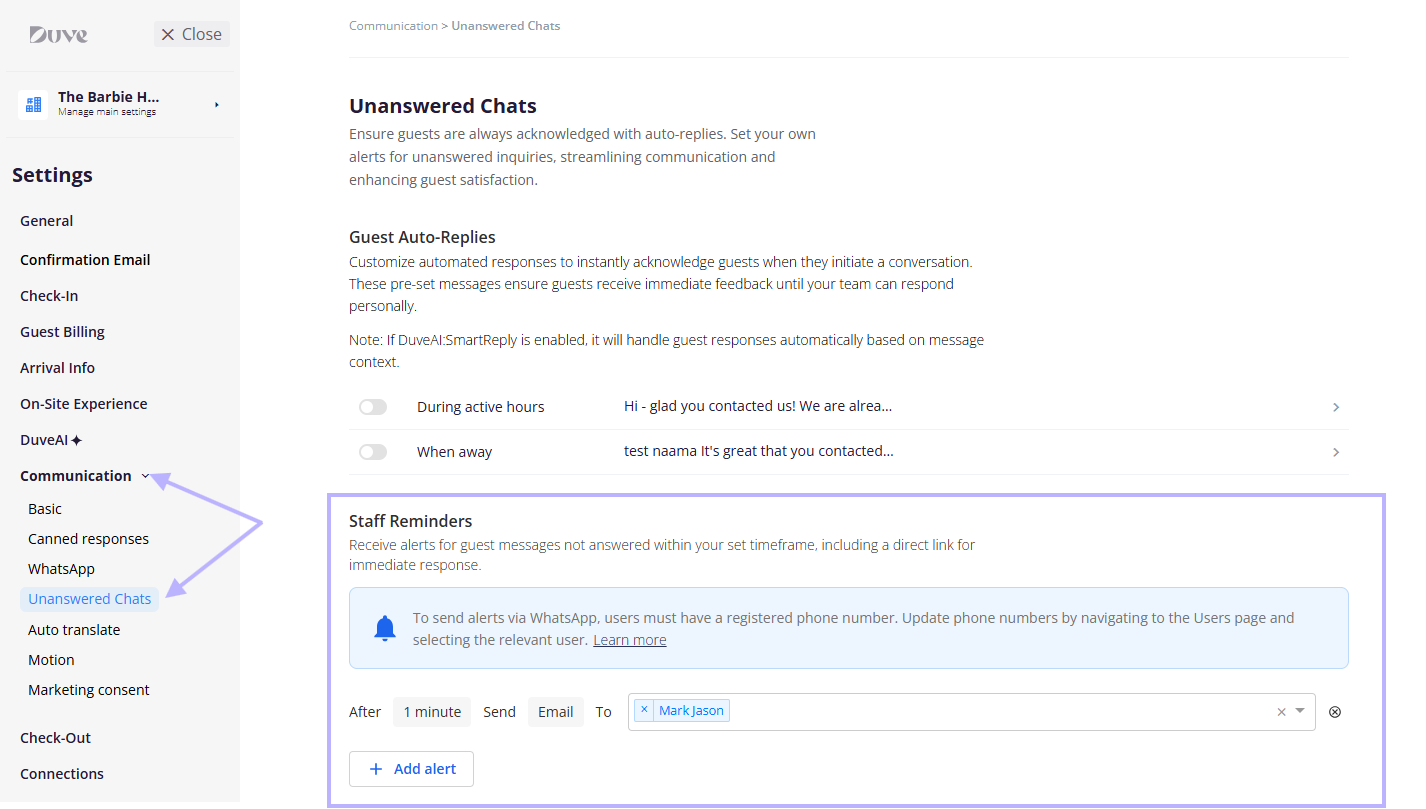
- Set the time frame and the channel for the alert.
-
In the To field, pick recipients from the sectioned list, which offers Staff members and Teams.
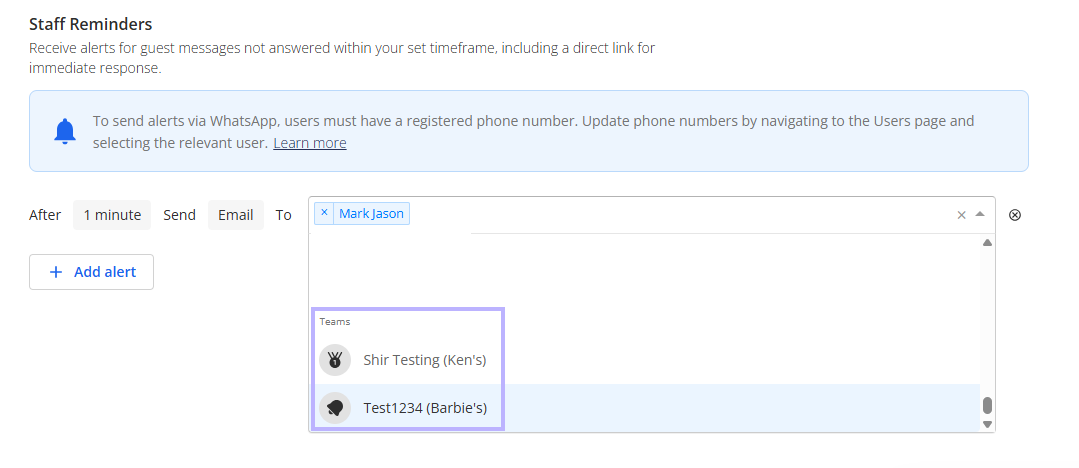
- Save your settings.
Troubleshooting note: You can mix individuals and teams in the same alert. If someone is picked individually and is also a member of a picked team, they still receive only one alert.
Notification behavior
- When a conversation is routed to a team, every member of that team except the person who routed it receives an assignment notification, along with the assignment email. Each member receives it according to their own notification channel preferences.
- To add the alert notification, enter Profile > Notifications > Conversation section > Mark the relevant notification (to get an alert when the team is assigned, set the notification for "Assigned to conversation"
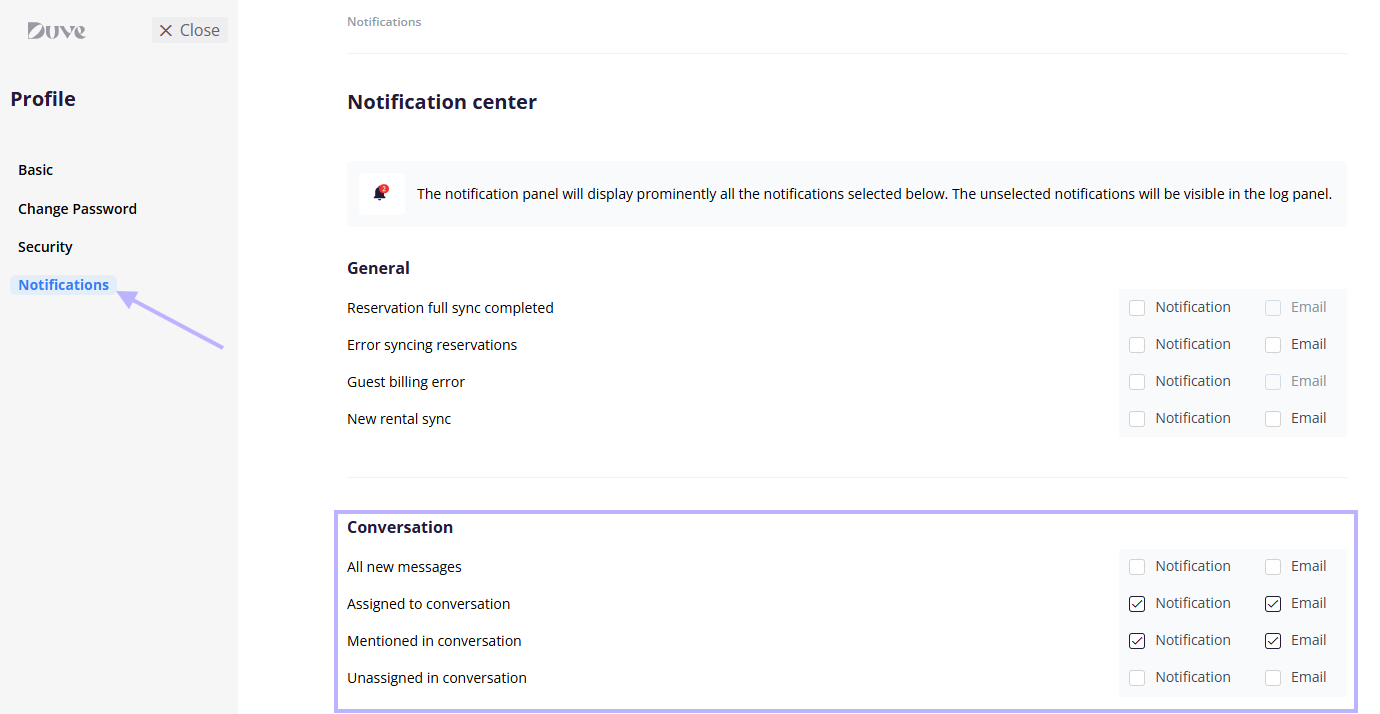
- To add the alert notification, enter Profile > Notifications > Conversation section > Mark the relevant notification (to get an alert when the team is assigned, set the notification for "Assigned to conversation"
- If the conversation was previously assigned to an individual, that person receives an unassigned notification (only if the notification is marked).
- When a reminder alert names a team, all eligible members of that team are notified. Eligibility depends on the channel: members need a valid email address for an email alert, and a valid phone number for a WhatsApp alert. Members who are missing the required detail for that channel are skipped.
- Members are also filtered by brand permissions, so a member is only alerted for brands they have access to.
Restrictions & limitations
- A conversation has a single assignment slot. It can be assigned to one individual or one team, never to several at once.
- Assigning a conversation to a team replaces any previous individual or team assignment, and assigning it to an individual replaces the team.
- Routing to a team is manual only. There is no automated or AI-based routing to a team.
- The Teams section does not appear in the assign dropdown when the conversation has no eligible teams, for example, when no team has been created yet, or no team matches the conversation's brand.
- Team names are limited to letters, numbers, and spaces, up to 20 characters. Punctuation and symbols are rejected.
- A team can be linked to one brand at most.
- A team must always have at least one member.
- Team membership is not shown as an editable field when you first create a user. Create the user, then open them again to set their teams.
Troubleshooting
- The team I want is not in the assign dropdown. Teams are scoped to brands. Check that the team's brand matches the conversation's brand, or that the team was created at the account level. Also check that the team still exists.
- I get a name error when saving a team. The name is already used by another team in the same scope, or it contains characters other than letters, numbers, and spaces, or it is longer than 20 characters.
- I cannot remove someone from a team. They are the last member. A team cannot be left empty, so add someone else first or delete the team.
- A conversation shows as unassigned even though it was routed to a team. The team was probably deleted. Deleted teams are shown as unassigned, and the event feed shows the action as coming from a deleted team.
- A team member did not receive a reminder alert. Check that they have the details the channel requires, a valid email for email alerts and a valid phone number for WhatsApp alerts, and that their brand permissions cover the relevant brand.
Tips & tricks
- Name teams after the service the guest is asking about, not after a shift or a person, so the routing choice stays obvious to whoever is triaging.
- Use the icons to make teams easy to scan in the assign dropdown and the inbox list at a glance.
- If you run multiple brands, note that team names are shown with the brand in parentheses, for example "Front Desk (Herods London)", whenever your visibility spans more than one brand. This makes it safe to reuse the same team name per property.
- Create teams at the account level for functions that genuinely serve every property, and at the brand level for everything else, so the assign dropdown stays short.
- Point your unanswered-chat reminders at a team rather than at a list of names, so the alert keeps working when people join or leave without anyone having to edit the alert.
FAQs
Q: Where do I create a team?
A: In Settings › Users & Teams, on the Teams tab.
Q: Who can create or delete a team?
A: Admins and Managers who also have the "View & edit company settings" permission. Agents and Staff can see teams and assign conversations to them, but cannot manage them.
Q: Can a person belong to more than one team?
A: Yes. There is no limit on how many teams a user can belong to.
Q: Can a conversation be assigned to two teams, or to a team and a person at the same time?
A: No. A conversation has one assignee. Assigning a team replaces whatever was there before, and assigning a person replaces the team.
Q: What happens when someone takes over a conversation routed to their team?
A: They assign it to themselves, and they become the assignee in place of the team. The team assignment is cleared.
Q: Can I see conversations assigned to a team I am not part of?
A: Yes. Conversations assigned to any team are visible in the inbox, not only to that team's members.
Q: Does Duve route conversations to a team automatically?
A: No. Team routing is manual. There is no automated or AI-based team routing.
Q: Who gets notified when I route a conversation to a team?
A: Every member of the team apart from you, according to each member's own notification settings. If the conversation previously had an individual assignee, that person is notified that they have been unassigned.
Q: Will someone be notified twice if they are selected individually and through a team in the same reminder alert?
A: No. Recipients are deduplicated, so each person receives one alert.
Q: What happens to open conversations when I delete a team?
A: They become unassigned. The confirmation pop-up warns you before you delete, and the action is irreversible.
Q: Can I add myself to a team?
A: Yes, both when creating a team and when editing one.
Q: Why does a team name show a brand in parentheses?
A: Because your visibility spans more than one brand. The brand suffix tells you which property the team belongs to. Account-level teams are shown without a suffix.
Q: Can a team belong to more than one brand?
A: No. A team is either linked to a single brand or created at the account level.
Q: Can I change a user's teams while creating the user?
A: Not at the moment. Create the user first, then open their settings and set the Teams field.
Q: Are there rules on team names?
A: Yes. Letters, numbers, and spaces only, up to 20 characters, and the name must be unique within its brand or at the account level.
Related articles:
User Permissions and managing users
Comments
0 comments
Article is closed for comments.