
Overview
By default, the e-signature step of Duve's online check-in shows a registration card built from your Duve template. If your property is connected to Oracle Hospitality Integration Platform (OHIP) only, you can switch that step to show your property's own PMS-generated registration card instead.
When this is turned on:
- Duve pulls the registration card PDF for the reservation directly from Opera Cloud at the moment the guest reaches the signature step.
- The guest reads the official card in a built-in PDF viewer, with zoom, page navigation, and full screen.
- The guest's handwritten signature is stamped onto that PDF, so the signed document is your property's card, not a Duve-generated one.
- The signed PDF is stored in Duve and pushed back to Opera Cloud as a file attachment on the reservation.
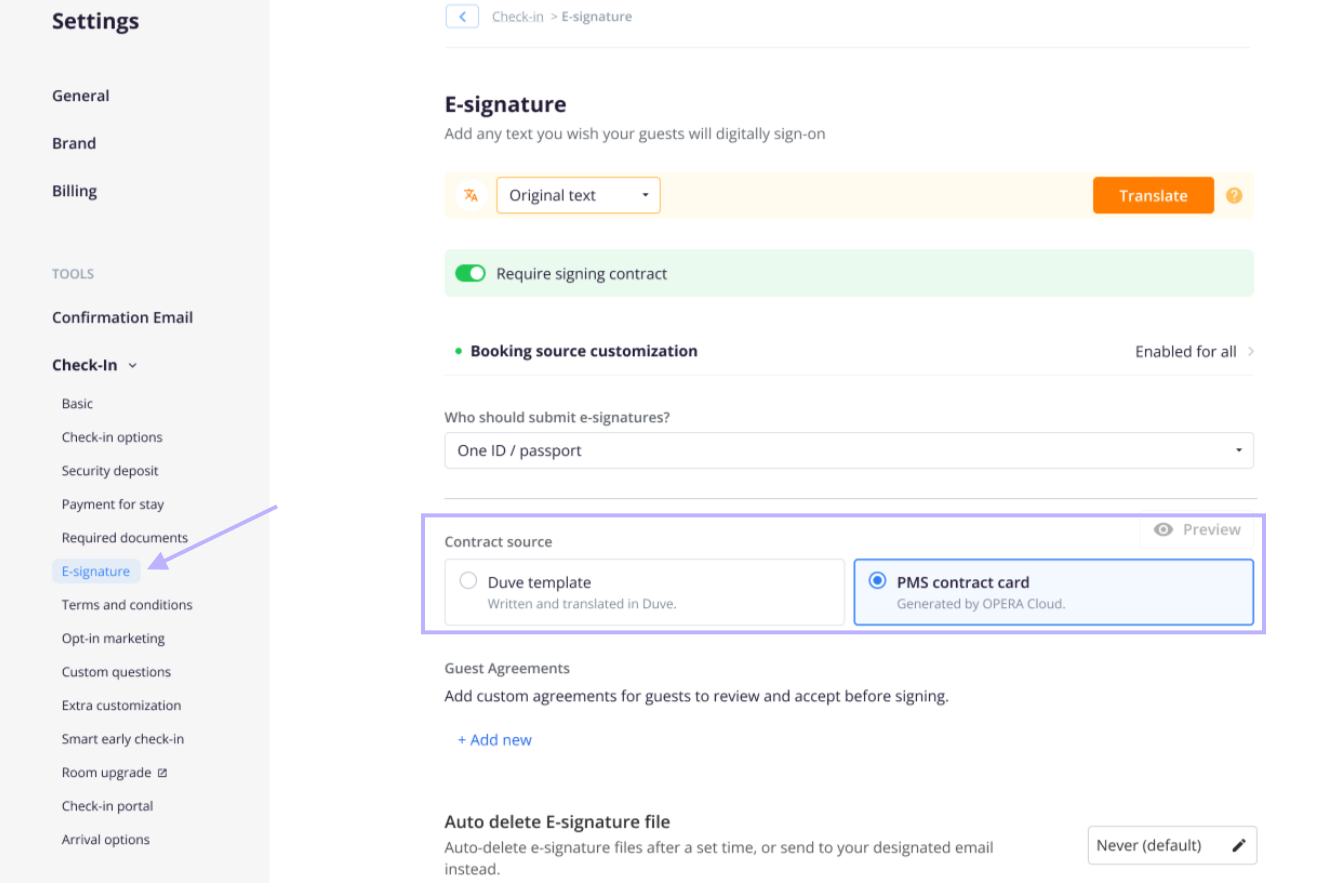
The setting is generic by design and is called "Contract source", with two options: "Duve template" and "PMS contract card".
Applies to
|
Use cases
- Brands with a legally reviewed registration card that must be signed exactly as the PMS generates it, including rate, folio, and policy wording.
- Properties that need the signed registration card filed back on the Opera Cloud reservation for audit or local authority purposes.
- Groups where some brands must use the PMS card, and others keep the Duve template, set through a brand override.
- Front desk check-in on a tablet, where the guest signs the official card on the device instead of a printed copy.
- Properties that want to collect extra consent statements (for example, house rules or marketing opt-in) alongside a PMS card that cannot itself be edited.
Before you start
- Confirm the reservation mapping to Opera Cloud is in place, since Duve requests the card by the reservation's external PMS ID.
- Confirm that the registration card itself is configured and generating in Opera Cloud. Duve displays whatever Opera returns and does not build or edit the card.
- Make sure E-Signature is enabled, because the Contract source cards are disabled while "Require signing contract" is off.
How to set it up
- Go to Settings > Check-in tab > E-Signature.
- Turn on the requirement to sign a contract if it is not on already.
- Choose who needs to sign (only the booker, all adults, or adults and children). This applies to the PMS card the same way it applies to the Duve template.
- In the Contract source section, select the "PMS contract card" card. The selection saves with the rest of the page.
- Optional: add Guest agreement statements. When the PMS card is selected, a Guest agreement section appears at the account level where you can add checkbox statements, mark them as mandatory, limit them to specific brands, and reorder them by dragging.
- Save the settings page.
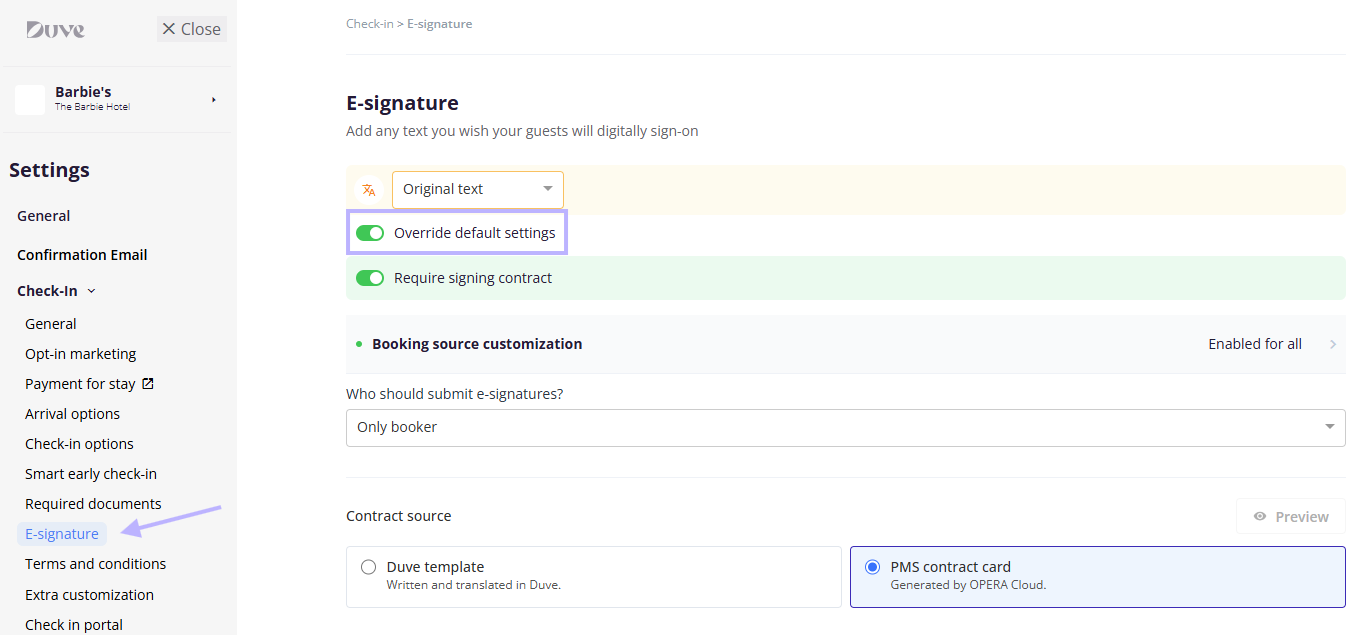
To override the source for a single brand:
- Open the brand's settings and go to its E-Signature section.
- Turn on "Override default settings".
- Select the contract source for that brand. A brand that overrides e-signature without setting a source keeps inheriting the account value, so you can override in either direction.
Host experience
- The Contract source section appears only when an Opera Cloud or OHIP source is connected, and the feature is enabled for your account.
- Selecting "PMS contract card" hides the Duve contract title field and the Duve contract editor, since neither is used anymore.
- The Preview button for the e-signature page is disabled while the PMS card is selected, because the card is generated per reservation by Opera Cloud and there is nothing static to preview.
- The Guest agreement list is configured at account level only and applies to the reservations that use the PMS card.
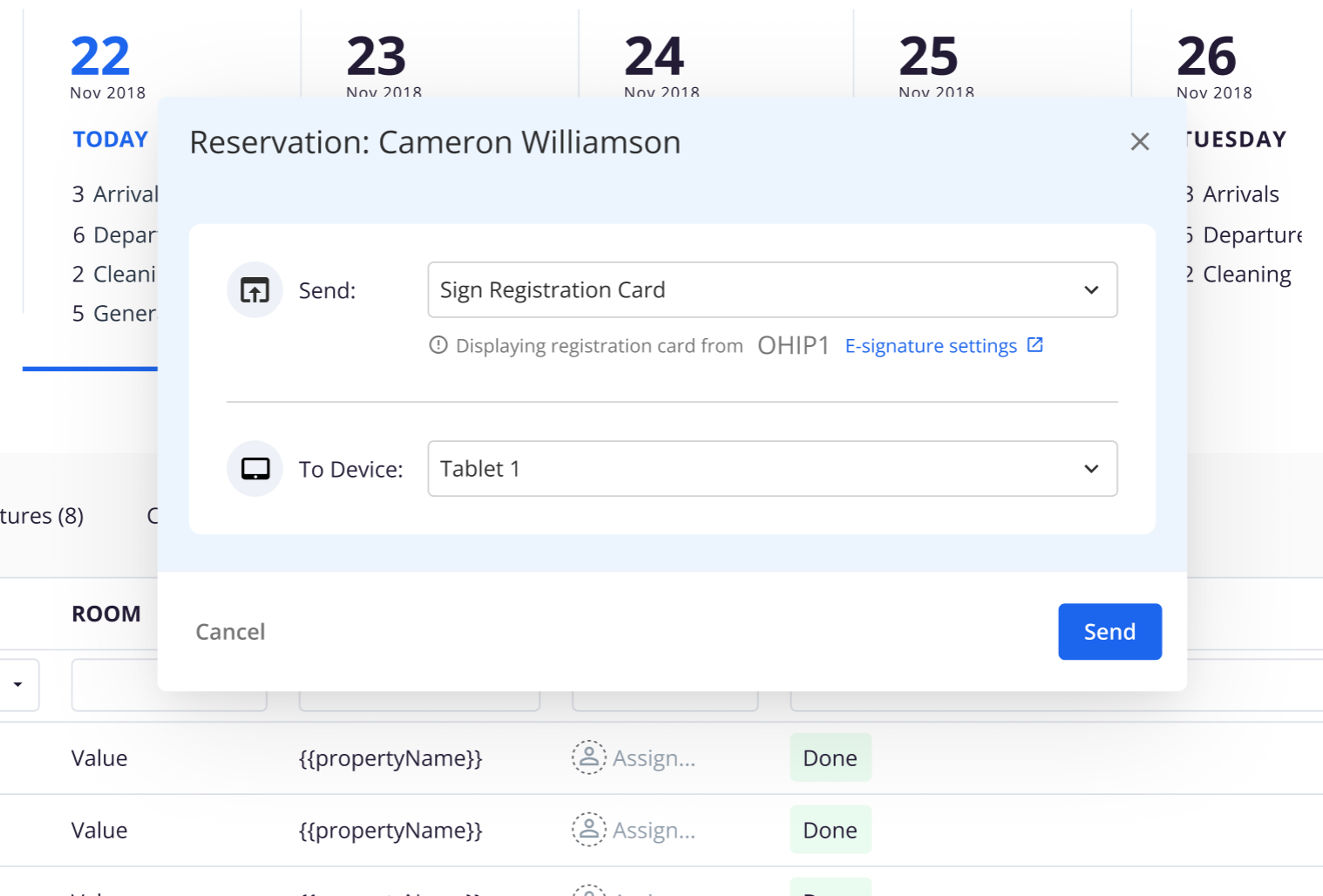
- When you send a check-in screen to a device from a reservation, and the selected screen is "Sign registration card" or the digital registration flow, the send popup shows a note that the registration card is coming from your PMS, with the integration name and a link to the E-Signature settings.
How it works with staff-assisted check-in
Staff-assisted check-in is the flow where an agent sends a check-in screen from Duve to a connected device at the desk, such as a tablet handed to the guest. The contract source applies there exactly as it does online, because the device opens the same guest check-in screens rather than a separate kiosk app.
What this means in practice:
- When the account or brand is set to "PMS contract card", a guest signing on the device sees the Opera Cloud registration card, not the Duve template.
- The PDF viewer, the zoom and full-screen controls, the Guest agreement checkboxes, the signature pad, and the blocking screen on failure are all the same as in online check-in.
- The signed card is stamped, stored, and pushed back to Opera Cloud in the same way, so it makes no difference whether the guest signed at home or at the desk.
- Nothing extra needs to be configured for the device. Choosing the contract source once covers both flows.
Sending the registration card to a device
- Open the reservation and choose to send a screen to a device.
- Under "Share for", choose the entire room or a specific guest. Both "Sign registration card" and the full digital registration flow can be sent to a specific guest.
- Under "Send", choose either the single "Sign registration card" screen or the "Digital registration" flow, which runs several check-in pages in sequence.
- When the reservation uses the PMS card, a note appears under the screen selector saying the registration card is being displayed from your PMS, with the integration name and a link to the E-Signature settings. The note shows for the single registration card screen and for the digital registration flow.
- Choose the device and send. Disconnected devices are listed as unavailable, and sending to one returns an error asking you to reconnect it or pick another device.
Choosing which pages the digital registration flow includes
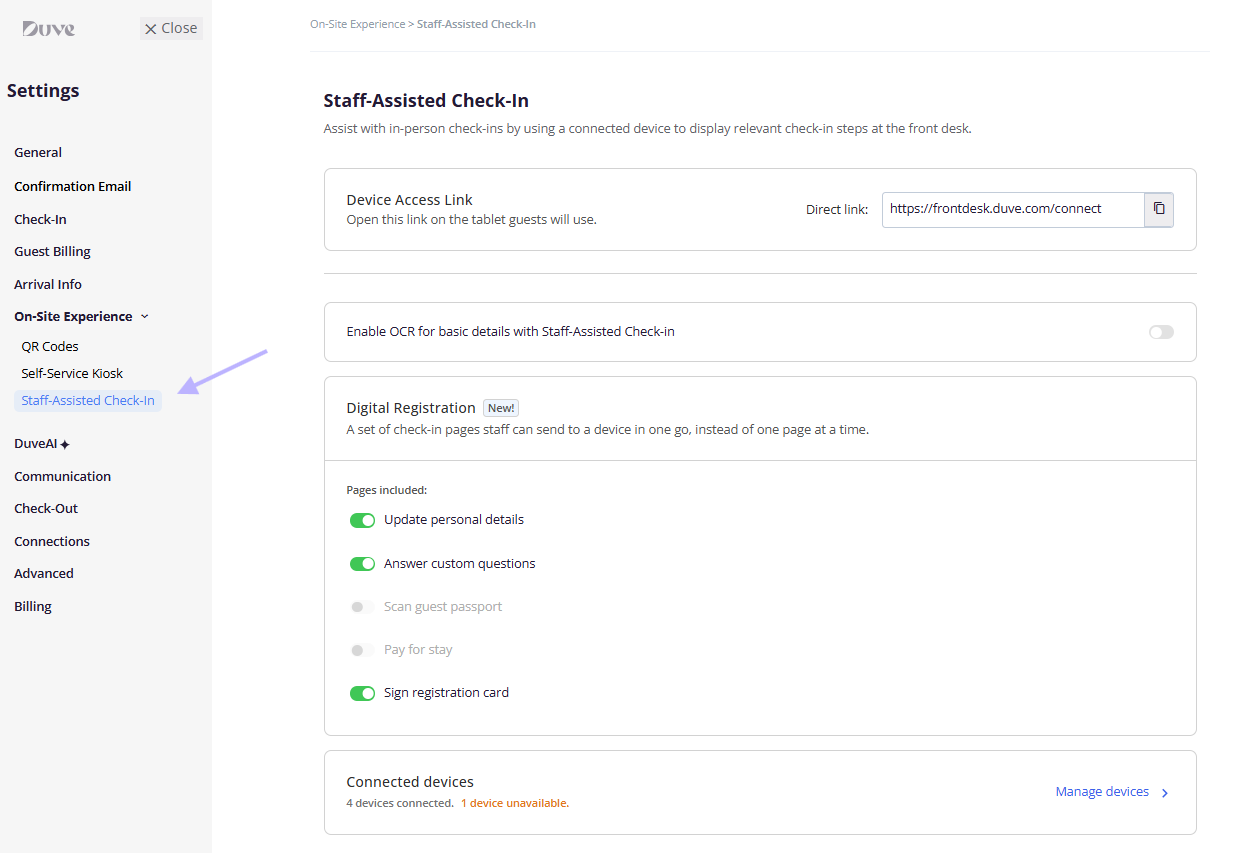
- Go to Settings and open the Staff Assisted Check-in page.
- Under "Digital registration", turn on the pages the flow should include. The available pages are updating personal details, answering custom questions, scanning a passport or ID, paying for the stay, and signing the registration card.
- "Sign registration card" is the page that renders the contract source. With it off, the flow runs without a signature step, and the card is not shown on the device.
- A brand can override the selection with the "Override options" toggle on the brand's page.
- If no pages are enabled at all, the digital registration option cannot be sent, and the send fails with an error saying there are no pages to run.
- These settings sit behind the control devices feature, so the page shows an upgrade message if your plan does not include connected devices.
Guest experience
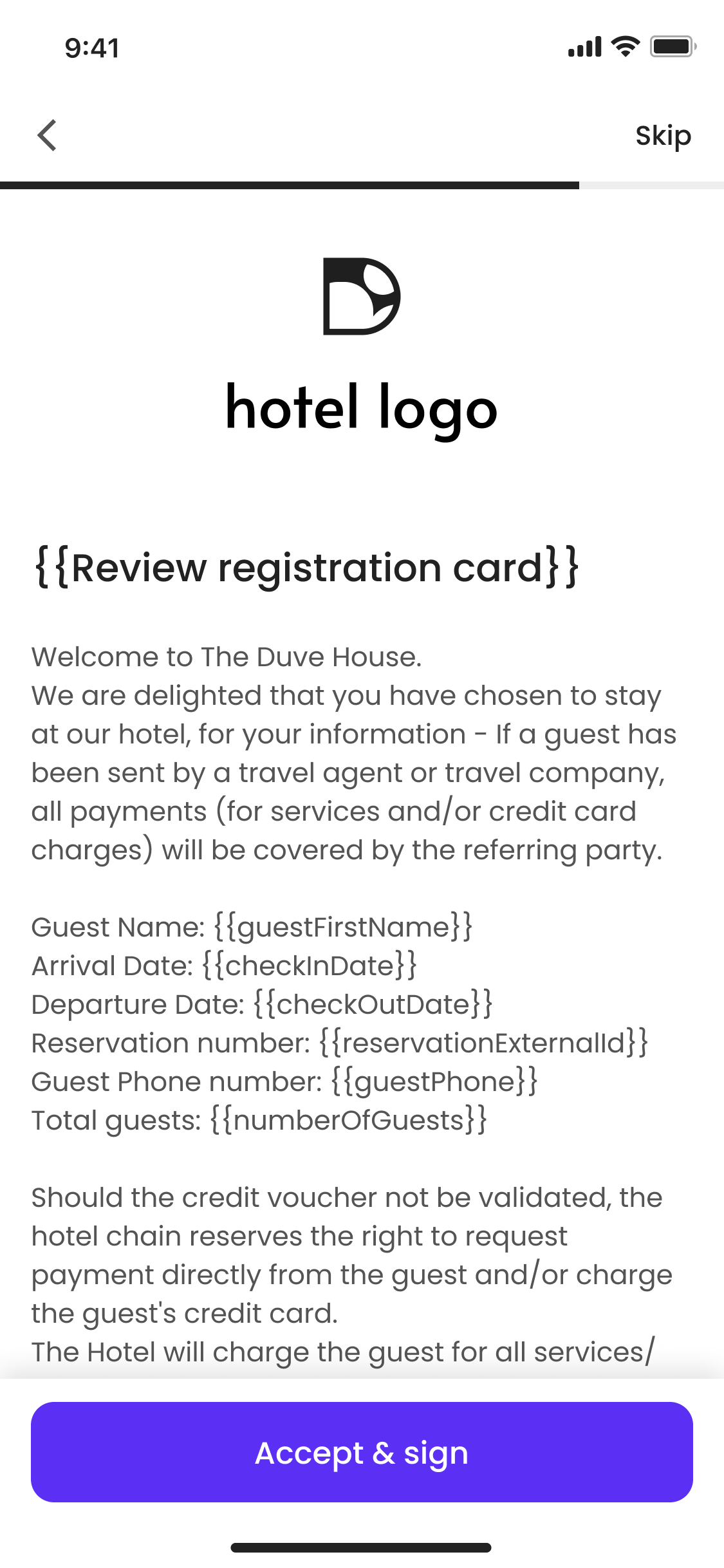
- At the signature step, the guest sees the PMS registration card rendered as a PDF rather than the Duve template.
- The viewer provides zoom in and zoom out, page navigation when the card has more than one page, and a full-screen toggle. On iOS, a pinch gesture in full screen zooms the card.
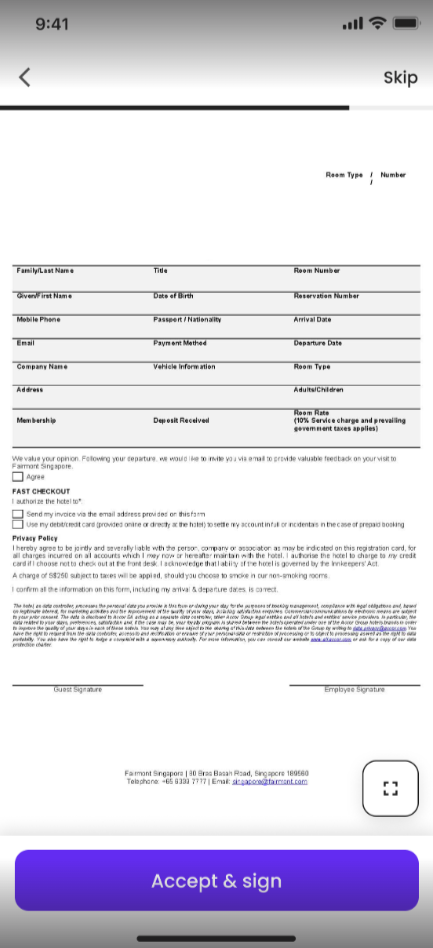
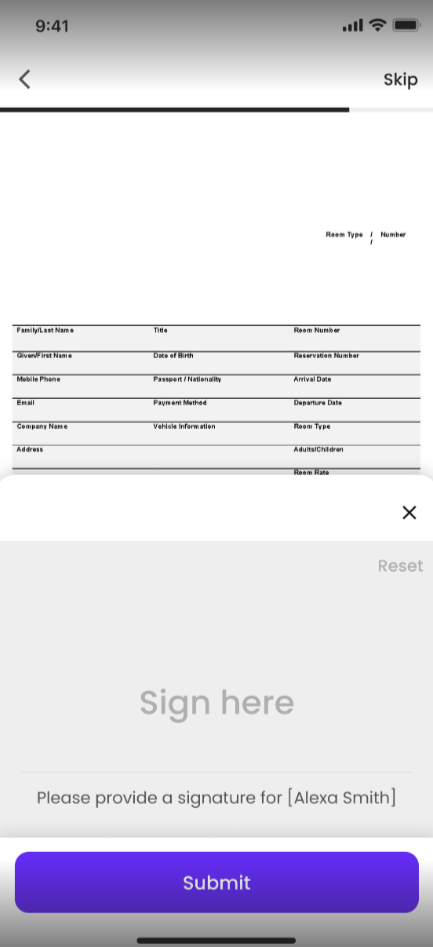
- The guest taps "Accept & sign", which opens the signature sheet. While the sheet is open, the card returns to its normal scale so the guest can see what they are signing.
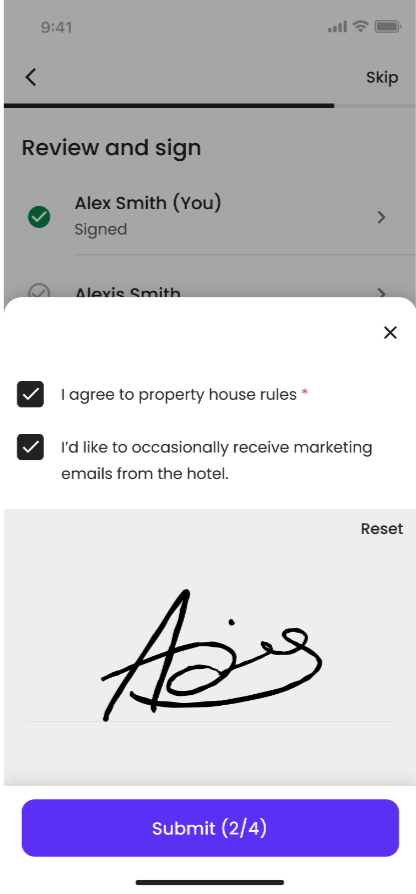
- Any Guest agreement statements you configured appear as checkboxes above the signature pad. Mandatory statements must be ticked before the signature can be submitted.
- After submitting, the signature is stamped onto the card PDF inside a labeled signature box, at the bottom of the last page where there is free space, and on an appended page when there is not. The stamp never covers existing content on the card.
- The agreement statements are stamped too, as a ticked or unticked checkbox with the statement text, just above the signature box.
- When more than one guest must sign, each guest signs in turn, and the progress counter shows the position in the list.
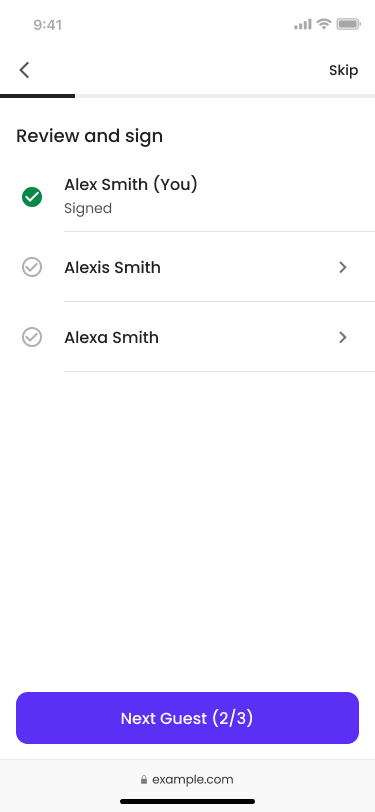
- The signed PDF is saved in Duve and pushed back to Opera Cloud. The guest is never held up by that push.
Troubleshooting
- If the card cannot be fetched, the guest sees a blocking screen with an error, a "Try again" button, and a link to skip and sign at the front desk on arrival. Duve retries the fetch automatically, up to three attempts inside a 30-second window, before showing it.
- Duve never silently falls back to the Duve template when the PMS card fails. If the guest skips, the online check-in step stays incomplete, and the card can be signed at the front desk.
- A guest who pressed "Try again" and still fails usually points to an Opera Cloud side issue, such as the card not being generated for that reservation or the integration being down. Check the Opera Cloud reservation first.
- If the Contract source section disappeared from Settings, check whether the Opera Cloud or OHIP source was disconnected. The stored value stays as it was, and guests on that account hit the blocking screen until the connection is restored or the source is switched back to the Duve template.
- If guests see the Duve template rather than the card, check the brand override. A brand override can point a brand back at the Duve template while the account uses the PMS card.
Restrictions and limitations
- Opera Cloud (OHIP) only. Opera on-prem (v5) and every other PMS are not supported.
- The card cannot be edited in Duve. Content, layout, and language come from Opera Cloud, so wording changes are made in the PMS.
- The e-signature page Preview is not available while the PMS card is selected.
- The Duve contract title and contract editor are hidden and unused while the PMS card is selected.
- Guest agreement statements are configured at account level, not per brand, although each statement can be limited to specific brands.
- Re-signing is not triggered automatically if reservation details change after the guest has signed.
- If Opera Cloud cannot accept the file upload, Duve records a link to the signed PDF instead of filing it as an attachment. The signed document is still stored in Duve.
Tips and tricks
- Test with a real reservation on a test property before rolling the setting out, since the card is generated per reservation and cannot be previewed.
- Use Guest agreement statements for anything the PMS card does not cover, for example, house rules, parking terms, or marketing consent. They are stamped onto the signed card, so the consent lives on the same document.
- Keep agreement statements short. Each one is stamped on a single line and is shortened with an ellipsis if it does not fit the page width.
- Roll out brand by brand with the brand override, and keep the account default on the Duve template until you are satisfied.
- Right-to-left languages such as Hebrew and Arabic are aligned correctly in the guest viewer, so a card in those languages is readable without zooming.
- The analytics event for the contract step records which source was used, so you can compare completion between the Duve template and the PMS card.
FAQs
Q: Does this replace the Duve registration card entirely?
A: Only for the accounts or brands you switch over. Anything still set to "Duve template" keeps the existing behavior, and you can switch back at any time.
Q: Can I edit the PMS registration card in Duve?
A: No. The card is generated by Opera Cloud, and Duve displays it as is. Changes to the content are made in the PMS.
Q: Why is the Preview button grayed out?
A: Preview is disabled when the PMS contract card is selected because the card is generated per reservation and there is no static template to preview.
Q: Where does the signature appear on the card?
A: At the bottom of the page when there is free space, and on an extra page appended to the document when there is not. Existing content on the card is never covered.
Q: What happens to the signed card after the guest signs?
A: It is stored in Duve with the reservation's signed documents and pushed back to Opera Cloud as a file attachment. If the upload is unavailable or fails, Duve records a link to the signed PDF as a fallback and logs the failure. The guest flow is not blocked either way.
Q: What does the guest see if Opera Cloud does not return the card?
A: A blocking screen with an error message, a "Try again" button, and an option to skip and sign at the front desk on arrival. Duve does not fall back to the Duve template, and the step stays incomplete if the guest skips.
Q: Can different brands use different sources?
A: Yes. Turn on the e-signature override for the brand and pick the source there. A brand that overrides e-signature without choosing a source keeps inheriting the account value.
Q: Does it work with staff-assisted check-in and send to device?
A: Yes. The device opens the same guest signature step, so it shows the PMS card and pushes the signed document back in the same way. The send popup tells the agent which integration the card is coming from.
Q: Can I still ask guests to accept extra terms?
A: Yes. Add them as Guest agreement statements. They appear as checkboxes next to the signature pad, can be made mandatory, and are stamped onto the signed card with the guest's answers.
Q: Does the card come in the guest's language?
A: The card is produced by Opera Cloud, so the language follows what the PMS generates for that reservation. Duve does not translate it.
Q: Why do I not see the Contract source setting at all?
A: Either the account has no active Opera Cloud or OHIP connection, the only Opera connection is on-prem v5, or the feature has not been enabled for your account yet. Contact your Duve representative to have it enabled.
Comments
0 comments
Article is closed for comments.